
Short answer: yes, you can sell a house as-is in Colorado, and you don’t have to fix anything first. But “as-is” doesn’t let you stay quiet about problems you know about, and it doesn’t stop a buyer from inspecting the house and asking for changes or walking away. What you give up with an as-is sale is mostly price and negotiating room, not legal duties.
General information only, not legal or tax advice. If a specific problem with your house worries you, ask a Colorado real estate attorney before you sign.
In this guide
- What does selling a house as-is mean?
- What you still have to disclose
- What buyers can still do
- How much do you lose selling as-is?
- Sell as-is or fix it up first?
- Pros and cons
- Your options
- Colorado things to check
- Common questions
- Where to start this week
What does selling a house as-is mean in Colorado?
Selling as-is means you won’t make repairs or give credits for the condition of the house. The buyer takes it “As Is” and “Where Is.”
What the standard Colorado contract says about selling as-is
In the standard Colorado purchase contract that sentence begins with the words “Except as otherwise provided in this Contract.” That opening matters. Other parts of the same contract still apply, including your disclosure duties and the buyer’s right to inspect. A Colorado Lawyer article on this topic makes the point directly: the as-is clause does not reliably wipe out those other provisions. (Colorado Lawyer, “Is your client really selling their home ‘as is’?”)
So “as-is” is a price and repair decision. It is not a way to avoid telling the buyer what you know.
What you still have to disclose
Even in an as-is sale, three kinds of disclosure can apply:
- The Seller’s Property Disclosure. No Colorado statute generally requires a seller to complete one, but the standard contract does include a duty to provide it. Even if that paragraph is struck from the contract, a buyer can still sue for misrepresentation, nondisclosure or concealment. (Colorado Lawyer)
- Known problems the buyer can’t easily see. Colorado law requires a seller to disclose latent defects the seller actually knows about, meaning conditions a buyer wouldn’t find in a reasonable inspection. The contract also asks you to disclose adverse material facts you know of when you sign. The contract doesn’t define that phrase, so what you think is minor may look material to a court.
- Specific items set by statute. Two examples: a seller must tell the buyer in writing if they know the property was used as a methamphetamine lab (C.R.S. § 38-35.7-103), and every residential purchase contract must carry a bold statement about special taxing districts (C.R.S. § 38-35.7-101).
The simple rule: if you know about it and the buyer might not, write it down. Roof leaks, past water in the basement, foundation movement, a failed sewer line, unpermitted work. Disclosing a problem costs you some price. Hiding one can cost you a lawsuit.
What buyers can still do after you say “as-is”
- Inspect. The contract gives the buyer the right to inspections at their own expense.
- Object or walk. If the buyer isn’t satisfied, they can send an objection and negotiate, or terminate within the deadlines in the contract.
- Ask for a lower price or repairs. You can say no. They can leave.
- Run into lender rules. FHA and VA loans require the home to meet minimum property requirements: safe, structurally sound, and secure (FHA) or sanitary (VA). Cosmetic wear usually isn’t a problem, but safety hazards, roof, utility or drainage problems can be. A house with serious defects may not qualify for those loans, which narrows your buyer pool. (HUD Handbook 4000.1, VA Pamphlet 26-7, Chapter 12) A buyer paying cash isn’t bound by those rules.
None of this means as-is is a bad idea. It means “as-is” is the start of a negotiation, not the end of one.
How much do you lose selling a house as-is?
Everyone wants a number, and every website gives a different one. Pages from companies that sell cash offers quote anything from about 55% to 85% of a house’s value, usually without a source, and sometimes in the same article they contradict themselves. We aren’t going to add another invented number.
Here is what actually moves the gap between an as-is sale and a repaired, listed sale:
- How big the repairs are. A dated kitchen and a failed foundation are different problems.
- How many buyers can buy it. Fewer buyers means less competition, which means lower offers.
- How long you’d carry it. Mortgage, taxes, insurance, utilities and lawn or snow care continue until it sells.
- What you’d pay to list. Agent commission, repairs, staging, and closing costs come out of a listed sale.
- What the market is doing in your area. Fort Collins and Wheat Ridge are not the same market.
The way to find your number is to get it, not guess it. Get an as-is offer, get an agent’s estimate of what the house would list for after repairs, get repair bids, and fill in the costs. We made a one-page worksheet for exactly this: As-Is vs. Repair vs. Direct Sale Worksheet (PDF).
Should you sell as-is or fix it up first?
Repairs make sense when:
- The work is cheap relative to the price bump (paint, flooring, a deep clean, obvious small fixes).
- You have the time and cash to do it and can wait for a listing.
- The house would otherwise fail a buyer’s inspection or loan requirements.
As-is makes sense when:
- The repairs are big, uncertain or expensive.
- You can’t afford to carry the house for months.
- You live out of state, are managing an estate, or don’t want to coordinate contractors. (If the house is part of an estate, see our guides on inherited houses and selling a house in probate.)
- The house has tenant damage, deferred maintenance or a hoarding situation that would take months to resolve.
Many sellers do a middle version: small repairs plus a listing as-is. That can bring in more offers without a big project.
Pros and cons of selling a house as-is
Pros
- No repair bills or contractors to manage.
- Less prep: no staging, and less clean-out pressure.
- A simpler, often faster path, especially if you can’t carry the house for months.
- More certainty when you choose a buyer who commits to the house as it stands.
Cons
- Offers are often lower than for a repaired house, because buyers price in the work.
- Fewer buyers can qualify, since some loans have property requirements.
- Buyers can still inspect and negotiate or walk.
- You still have to disclose what you know, so “as-is” is no shield.
Your options for an as-is sale
| Option | What it usually means |
|---|---|
| List as-is with an agent | Your house reaches the widest group of buyers and may bring the highest price, but you still handle showings, inspection negotiations and a timeline you can’t fully control. Commission comes out of the proceeds. |
| Sell it yourself (for sale by owner) | You skip commission, but you handle pricing, marketing, showings, paperwork and negotiation on your own. |
| Sell directly to a buyer who purchases as-is, including for cash | You skip repairs, showings and some of the uncertainty, and can often pick a closing date. Offers tend to be below a repaired, listed price, so compare the net, not the headline. |
On any sale, Colorado charges a documentary fee of one cent per $100 of the price, rounded up, when the deed is recorded. (C.R.S. § 39-13-102) Some websites call this a transfer tax. For most sales it is a small amount, and who pays it is negotiable in the contract.
If you’d like to see what a direct as-is sale looks like in numbers, you can request a no-obligation cash offer and put it next to an agent’s estimate and your repair costs. You aren’t obligated to accept anything.
Colorado things to check before you decide
- HOA documents and special assessments. The buyer will want them. Ordering early avoids delays.
- Well and septic. Rural properties around Berthoud, Loveland and Windsor may have them, and buyers may test them.
- Hail and roof damage. Colorado hail is common. Know whether there are open insurance claims or repairs that were never done.
- Radon and basement water. If you’ve tested for radon or had water in the basement, tell the buyer what you know.
- Soil and foundation movement. In Gattis v. McNutt (Colorado Court of Appeals, 2013), sellers had engineering reports describing structural damage from expansive soils but didn’t disclose them to the buyers. The court allowed the buyers’ nondisclosure claim to go forward. If you’ve seen cracks or sticking doors, or you’ve had a report done, disclose what you know.
- Unpermitted work. Finished basements, additions and decks done without permits come up in inspections and appraisals.
- Liens and taxes. Your title company will find them. Know what’s owed before you set a price.
An example (a made-up scenario for illustration, not a specific client)
Say a homeowner in Colorado has a 1980s house with a leaking roof, an old furnace and 15 years of deferred maintenance. They assume that if they sell as-is, they don’t have to mention the roof. A friend tells them it’s still a disclosure issue.
They collect three things: an agent’s estimate for the house after repairs, two roofing quotes, and an as-is offer. They put the numbers on one page: expected price, minus commission, repairs and months of carrying cost, against the as-is number and a closing date they can choose. The repaired-and-listed route nets more on paper but takes about four months and requires thousands in upfront repairs they’d need to borrow. The as-is route nets less but closes sooner. They disclose the roof in writing either way, and pick the one that fits their situation.
The lesson isn’t that one route is always better. It is that you can’t know until you’ve put your own numbers side by side.
Common questions
Do I have to disclose problems if I sell as-is in Colorado?
Yes, for problems you know about that a buyer wouldn’t easily find. The as-is wording in the contract doesn’t remove your disclosure duties, and some disclosures are set by statute. Disclose what you know in writing.
Can a buyer still ask for repairs on an as-is sale?
Yes. The buyer can inspect and send an objection, and you can say no or negotiate. If you can’t agree, they can end the contract within the deadlines.
Can I sell as-is if I still have a mortgage?
Yes. The mortgage is paid off from the sale proceeds at closing. If the proceeds don’t cover the payoff and the costs, talk to your lender early. If payments have stopped, see our page on avoiding foreclosure.
Will I get less money selling as-is?
Often, yes, compared with a repaired and listed house, because you’re offering the buyer a project. By how much depends on the repairs, the buyers who can purchase it, how long you’d carry the house, and your local market. Use the worksheet to see your own numbers.
Do I need an attorney to sell as-is?
You aren’t required to hire one to sell a house in Colorado, and most closings are handled by a title company. The Colorado Bar Association still recommends talking to a real estate lawyer before you sign a listing contract. If you have a complicated issue (an estate, a lawsuit, a serious defect, a contract you don’t understand), an attorney is worth the cost. (Colorado Bar Association)
What does the buyer pay for in an as-is sale?
The buyer typically pays for their own inspections. Closing costs and the documentary fee are negotiated in the contract, so check who pays what before you sign.
Where to start this week
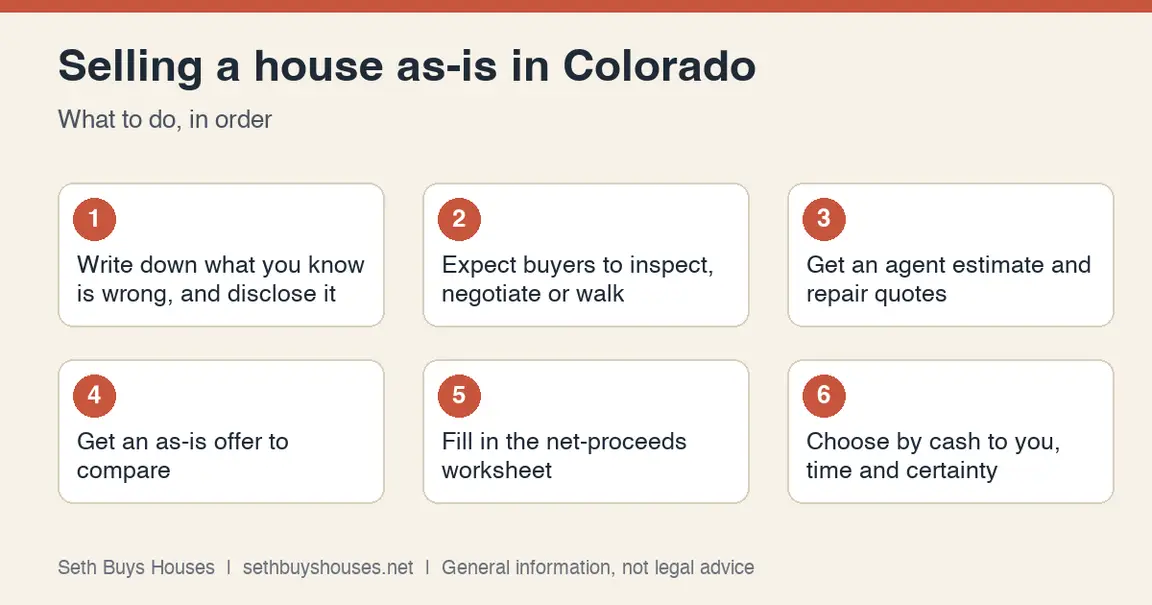
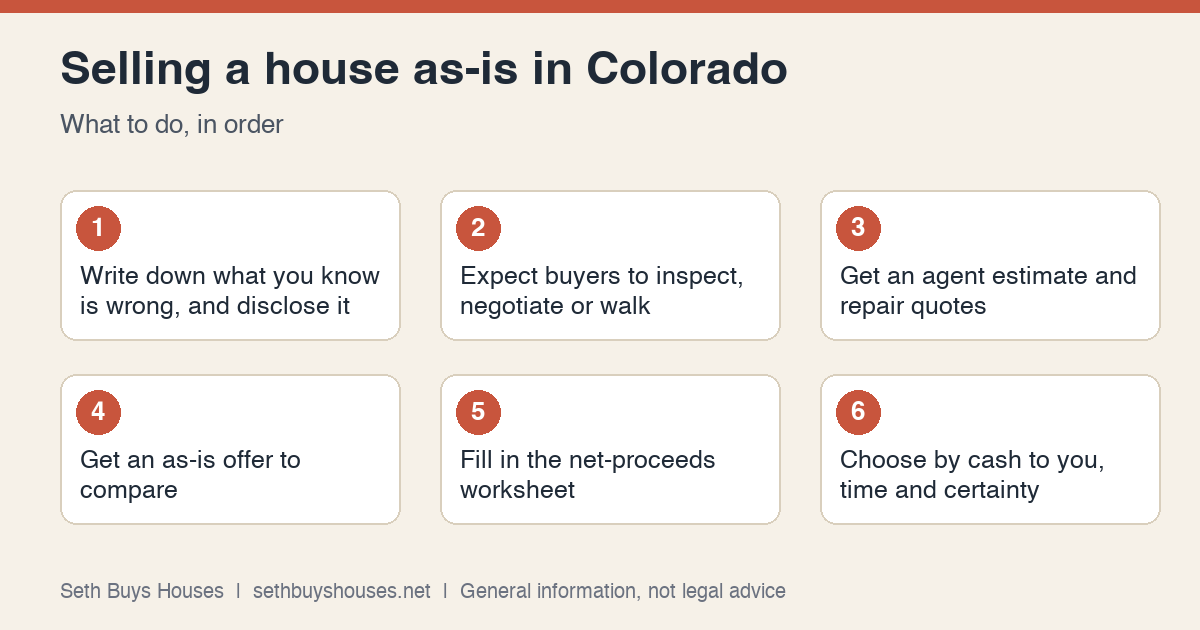
- Write down everything you know is wrong with the house, including things you’ve learned to live with.
- Collect your HOA documents, mortgage statement and tax information.
- Get an agent’s estimate for the house as-is and after repairs.
- Get one or two repair quotes for the biggest items.
- Get an as-is offer so you have a real comparison.
- Fill in the worksheet before you choose.
If you own a house in Fort Collins, Loveland, Wheat Ridge or elsewhere in Colorado and want to see what an as-is offer could look like, you can request a no-obligation cash offer.
Related guide: if you are weighing whether to skip the agent too, see selling a house without an agent in Colorado.
