
Short answer: yes, you can sell a house without an agent in Colorado. What you give up is the person who does the work, not the legal duties. You still owe the buyer written disclosures on radon, your water source, lead paint (older homes) and any known meth-lab history, plus anything you know about hidden defects. You also take on pricing, marketing, showings, the contract and the closing. Whether that saves money depends on the commission you were quoted and how much of your own time the job takes.
General information only, not legal or tax advice. Rules and forms change. For questions about your own contract or situation, ask a Colorado real estate attorney or your title company before you sign.
In this guide
- Can you sell a house without an agent in Colorado?
- What an agent actually does
- The paperwork a Colorado seller owes the buyer
- Who pays closing costs when you sell by owner
- Your three routes compared
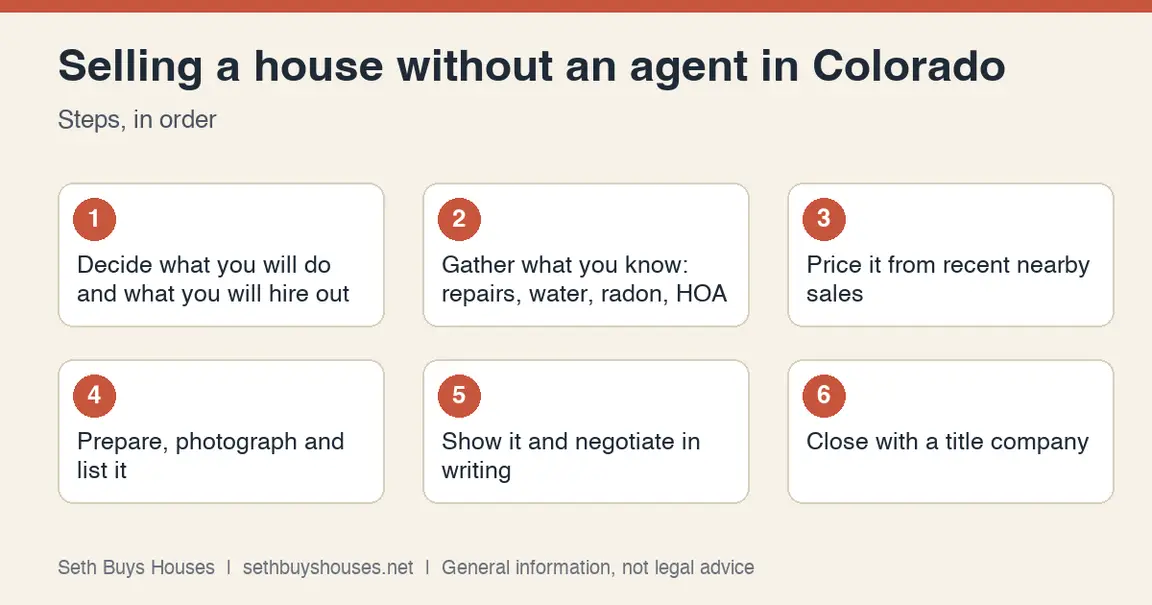
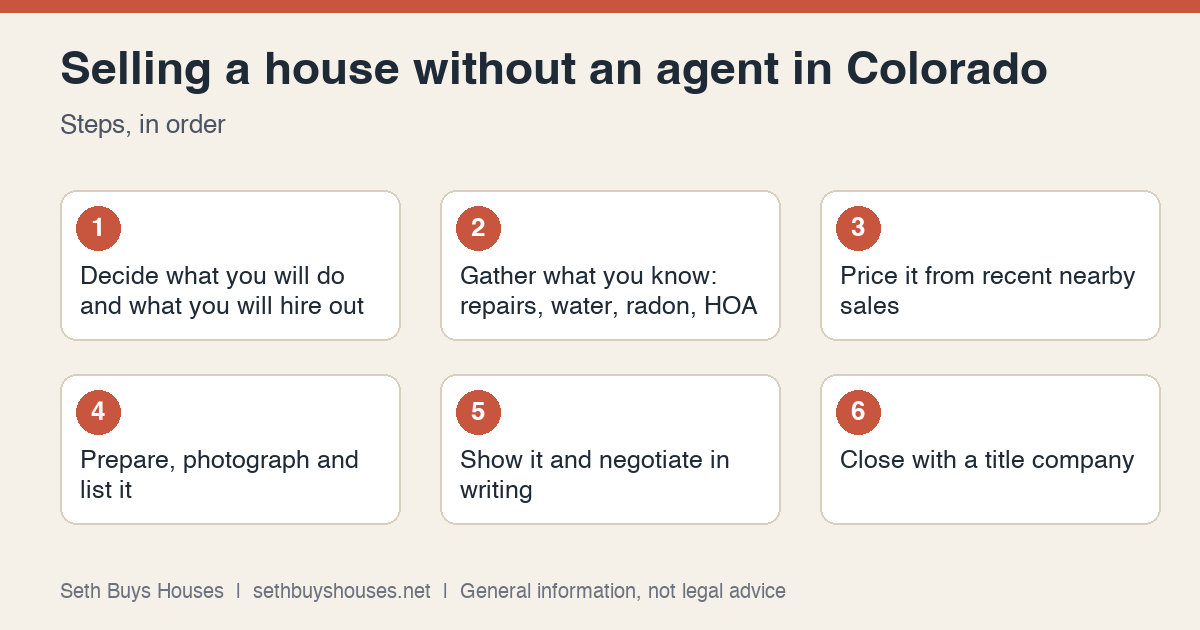
- Steps to selling your house yourself
- When selling on your own fits (and when it doesn’t)
- Colorado things to check
- Common questions
- Where to start this week
Can you sell a house without an agent in Colorado?
Yes. Every guide we read, from national sites to Colorado brokerages, agrees that an owner can sell their own home without a listing agent. The Colorado Division of Real Estate licenses brokers and publishes the contracts and disclosure forms they use. It does not publish a rule saying an owner must hire one. If you want certainty about what an unlicensed seller may do, ask a Colorado real estate attorney or your title company. (Colorado Division of Real Estate, contracts and forms)
One detail trips people up. The state’s page says its Commission-approved contracts and forms “are prepared for use by Colorado real estate brokers.” It does not say owners may use them, and it does not say they may not. So before you download a contract and start filling it in, ask a title company or attorney which contract you should use. That one question prevents a lot of rework.
What an agent actually does
It helps to look at the job in pieces. Selling without an agent means you do each of these yourself, or you pay someone else to do it.
| Task | What it involves | If you do it yourself |
|---|---|---|
| Price the house | Compare recent nearby sales, adjust for condition | You research sales and decide. Pricing too high is the most common reason homes sit. |
| Get it listed | Photos, description, getting it in front of buyers | You can post online yourself. Reaching the local listing service usually goes through a broker; some offer a flat-fee listing. Ask what is included. |
| Show the house | Scheduling, being present, screening visitors | You or a trusted person, at the buyer’s pace |
| Negotiate | Price, repairs, closing date, inspection objections | You, directly with the buyer or their agent |
| Write the contract | Terms, deadlines, contingencies | You need a contract that fits Colorado. A title company or attorney can supply or review one. |
| Handle disclosures | The forms and statements in the next section | You, in writing |
| Coordinate closing | Title company, lender, appraisal, deadlines | You and the title company |
None of that is secret knowledge. It is a list of tasks. The question is how much your time is worth, how long you can wait, and whether the commission you were quoted is larger than the cost of doing the work and hiring help where you need it.
The paperwork a Colorado seller owes the buyer
This is the part most pages gloss over. These are the items that matter for an owner-sold house, with where each one comes from.
The Seller’s Property Disclosure
The Division of Real Estate lists a Seller’s Property Disclosure (Residential) among its disclosure documents, along with a Source of Water Addendum, lead-based paint forms, a square footage disclosure and a green disclosure. (Colorado Division of Real Estate) Buyers expect to see a completed disclosure whether or not an agent is involved. Separately from any form, a Colorado seller must disclose latent defects they actually know about, meaning problems a buyer wouldn’t find in a reasonable inspection. (Colorado Lawyer) If you know about it and the buyer might not, write it down.
Where your drinking water comes from
Colorado requires the contract or seller’s disclosure for an owner-sold home to carry a bold statement of the property’s water source: a well, a water provider (with contact details), or neither (describe it). If it is a well, you also give the buyer a copy of the current well permit if one is available. (C.R.S. § 38-35.7-104, as published in the 2017 statutes on Justia; check the current text)
Radon
Since August 7, 2023, Colorado’s residential sales contracts must include a bold radon warning, and the contract or Seller’s Property Disclosure must say whether a radon test has been done. You also provide the most recent test records, a description of any concentrations found or mitigation work done, whether a mitigation system is installed, and a copy of the state health department’s radon brochure. (Colorado Division of Real Estate, SB23-206 advisory) Testing itself is the buyer’s choice. The disclosure is yours. The brochure comes from the Colorado Department of Public Health and Environment, so use its most recent edition.
Lead-based paint (houses built before 1978)
If the house was built before 1978, federal rules require you to give the buyer the EPA lead pamphlet, disclose known lead-based paint and hazards, hand over any records and reports, allow a 10-day window for a paint inspection or risk assessment (the buyer may waive it), and keep a signed copy of the disclosure for three years. (U.S. EPA, real estate disclosure) The rule puts the duty on sellers, and agents share responsibility when one is involved.
Methamphetamine lab history
A seller must tell the buyer in writing whether the seller knows the property was ever used as a methamphetamine lab. The statute expressly covers a home sold by the owner. A seller who knew and didn’t disclose can be liable for remediation costs, health-related injuries and attorney fees, and the buyer has three years from closing to sue. (C.R.S. § 38-35.7-103)
HOA documents and anything else the buyer asks for
If the house is in a homeowners association, the buyer will want its governing documents, budget and any special assessments. Ask the association what it can provide and how long it takes. Ordering early avoids delays at closing.
The contract itself
The contract sets deadlines for inspections, objections, financing and closing. It is the document where mistakes cost the most. Colorado’s Bar Association says there is no rule that you must hire an attorney to sell a home, but it still recommends talking to a real estate lawyer before you sign a listing contract. (Colorado Bar Association) For an owner sale, a one-time attorney or title-company review of the contract is often worth the cost.
Who pays closing costs when you sell by owner
There is no single answer, because the contract decides. These are the line items to expect, and each one is something to settle before you sign:
- Mortgage payoff and recorded liens. Paid from the proceeds at closing.
- Title and closing company charges. Who pays each fee is set in the contract.
- Colorado documentary fee. One cent per $100 of the price, rounded up, collected when the deed is recorded. Some sites call it a transfer tax. Who pays it is negotiable. (C.R.S. § 39-13-102)
- Prorated property taxes and HOA dues. Split by closing date.
- Repairs or credits agreed after the buyer’s inspection.
- Buyer’s agent compensation, if the buyer has an agent. Ask your title company or attorney how that is handled in your sale before you set a price, so it doesn’t surprise you at the table.
We aren’t giving a percentage, because the right number depends on your price, your contract and your title company’s fee schedule. The worksheet below lets you fill in your own quotes.
Your three routes compared
| Route | What it usually means |
|---|---|
| List with an agent | The agent prices, markets, shows, negotiates and coordinates. The commission is paid from your proceeds. You choose the agent and negotiate the terms. |
| Sell it yourself | No listing agent, so no listing commission, but you do or pay for each task in the table above. A flat-fee listing service, a title company and an attorney can fill gaps. |
| Sell directly to a buyer | No showings or open houses, and you can often pick the closing date. Offers tend to be below what a repaired, listed house might bring, so compare the net, not the headline. |
The honest way to choose is to put the three numbers side by side: what you would keep after every cost, how long it takes and how much of your time it needs. We made a one-page worksheet for that: Net Proceeds Worksheet: Agent vs. On Your Own vs. Direct Sale (PDF). It has blanks for your own figures and no assumed numbers.
If you’d like to see what a direct sale looks like in numbers, you can request a no-obligation cash offer and put it next to an agent’s quote and your own estimate. You aren’t obligated to accept anything.
Steps to selling your house yourself in Colorado
- Decide what you will do and what you will hire out. A title company, attorney, inspector and photographer are common helpers.
- Gather what you already know about the house. Repair history, radon results, water source, HOA contact, age of the roof and systems.
- Price it from recent sales, not hope. Compare homes like yours that closed nearby in the last few months. An appraiser or agent can give a second opinion for a fee.
- Prepare the house. Clean, declutter and fix what is cheap to fix. If it needs more than you want to do, see our guide to selling a house as-is in Colorado.
- Get it in front of buyers. Good photos and an honest description. Ask what a flat-fee listing includes before you pay for one.
- Show it and screen buyers. Ask for proof of funds or a lender letter before negotiating.
- Negotiate in writing. Price, repairs, closing costs, closing date. Have your contract reviewed before you sign.
- Close with a title company. They run title, handle funds and record the deed.
When selling on your own fits (and when it doesn’t)
It tends to fit when:
- You know your local market or have a buyer lined up (a neighbor, a relative, a tenant).
- You have time, flexibility and patience for showings and paperwork.
- The house is in good shape and priced to match.
It tends not to fit when:
- You live out of state or can’t be present for showings.
- The house needs work you can’t or won’t do, or has a title or probate question. (For an estate, see our guides on inherited houses and selling a house in probate.)
- You are behind on payments and the clock matters. See our page on avoiding foreclosure.
- You don’t want to negotiate with buyers directly.
Many sellers land somewhere in the middle: price it with an agent’s opinion, hire a title company and an attorney for the contract, and handle the showings themselves.
Colorado things to check
- Hail and roof damage. Colorado hail is common. Know whether there are open insurance claims or unrepaired damage.
- Well and septic. Properties near Berthoud, Loveland and Windsor may have them, and buyers may test them.
- Radon and basement water. Tell the buyer what you know.
- Soil and foundation movement. If you’ve seen cracks or sticking doors, or had a report done, disclose what you know.
- Unpermitted work. Finished basements, additions and decks done without permits come up in inspections and appraisals.
- Liens and taxes. Your title company will find them. Know what’s owed before you set a price.
An example (a made-up scenario for illustration, not a specific client)
Say a homeowner in Colorado is getting ready to sell and has been quoted a listing commission by two agents. They are tempted to skip the agent entirely. Before deciding, they fill in three columns on one page: the agent route, the on-your-own route and a direct sale. For each they write the expected price, the commission or listing fee, repairs, months of mortgage and utilities while waiting, title and closing charges and the documentary fee.
Doing it on their own saves the listing commission on paper, but it adds a flat-fee listing, an attorney’s contract review and several weekends of showings. The direct sale has the lowest price and the shortest wait. The agent route has the highest expected price and the least work. None of the three wins for everyone. The page makes the trade-offs visible, and they choose the one that fits their time and finances.
Common questions
Is it legal to sell a house without a real estate agent in Colorado?
Yes. An owner can sell their own home. What does not go away are your disclosure duties and the contract deadlines. Ask a title company or Colorado attorney which contract to use.
What paperwork do I need to sell my house myself in Colorado?
At minimum, a purchase contract, a Seller’s Property Disclosure, the water source statement, the radon disclosure and brochure, lead-based paint disclosures if the house was built before 1978, and written disclosure of any known meth-lab history. HOA documents if you’re in an association. Your title company will tell you what else the closing needs.
Who pays closing costs when selling a house by owner?
It is set by your contract. Common items include the mortgage payoff, title and closing fees, the Colorado documentary fee, prorated taxes and HOA dues, and any repairs or credits you agree to. Settle each before you sign.
Do I need an attorney to sell without an agent?
You aren’t required to hire one, and most closings are handled by a title company. The Colorado Bar Association still recommends talking to a real estate lawyer before signing a listing contract. If you have a complicated issue (an estate, a lawsuit, a serious defect, a contract you don’t understand), an attorney is worth the cost.
Can I list on the MLS without an agent?
Reaching the local listing service usually goes through a broker. Some brokers offer a flat-fee listing for a set price. Ask what is included and what is not before you pay.
What if I owe more than the house will sell for?
Talk to your lender early. If payments have stopped, see our page on avoiding foreclosure.
Where to start this week
- Write down everything you know about the house: repairs, water source, radon results, HOA, age of the roof and systems.
- Get your mortgage payoff amount and your HOA documents.
- Get an agent’s price opinion and commission quote so you have a real comparison.
- Call a title company and ask which contract to use and what they charge.
- Fill in the worksheet with your own numbers.
- Decide which route fits your time and finances.
If you own a house in Fort Collins, Loveland, Littleton or elsewhere in Colorado and want to see what a direct offer could look like, you can request a no-obligation cash offer.
