
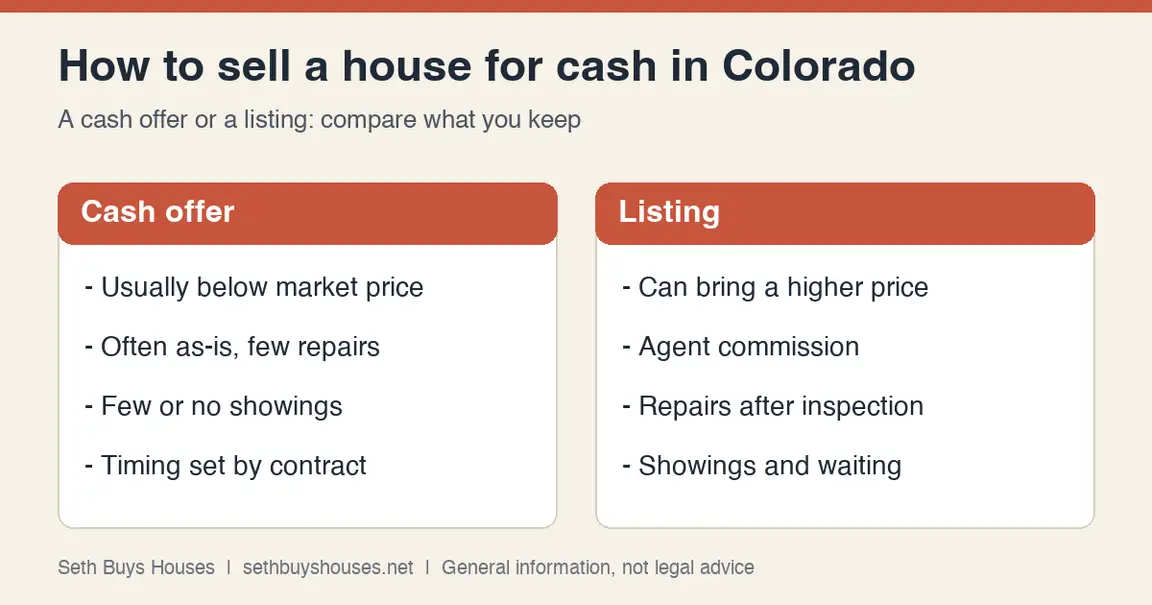
Short answer: if you want to know how to sell a house for cash in Colorado, a cash offer usually comes in below what a listing could bring, and it usually costs you less time, fewer repairs and no showings. A listing can bring a higher price, but you pay an agent, make the repairs a buyer asks for, and wait. The honest way to decide is to compare what you would keep after costs on each route, not the headline price. This guide shows how, with a worksheet.
General information only, not legal or tax advice. Rules and forms change. For questions about your own contract, ask a Colorado real estate attorney or your title company before you sign.
In this guide
- How selling a house for cash works
- Cash offer vs. listing, side by side
- Compare what you keep, not the price
- A worked example with made-up numbers
- Which route fits which situation
- What to check with any cash buyer
- Other routes worth knowing
- Colorado things to check
- Common questions
- Where to start this week
How selling a house for cash works
“Selling for cash” means the buyer pays without a mortgage. The buyer might be an investor, a house-buying company or an individual with the funds. Because no lender is involved, there is no loan approval to wait on, and the sale can fall apart less often for that reason.
In practice the steps look like this:
- You share the address and the condition of the house. Good buyers ask about the roof, the foundation, the kitchen and bathrooms, and anything you know is wrong.
- The buyer reviews the house, in person or from photos, and makes an offer. Some visit first. Ask which they do.
- You compare the offer with other options. A no-obligation offer means you can say no.
- If you accept, you sign a purchase contract and a title company or attorney handles the closing, the same as any sale.
- You move out by the agreed date and get paid at closing.
The part sellers feel most is that the buyer prices in the work and risk they are taking on. One national guide says investors often offer about 70 percent of what the house would be worth after repairs, minus the cost of those repairs (HomeLight). Another puts the investor figure near 67.5 percent of after-repair value (Clever). Both companies sell related services, so treat those numbers as marketing, not a rule. Your offer could be higher or lower. Get real offers instead of trusting an average.
Cash offer vs. listing, side by side
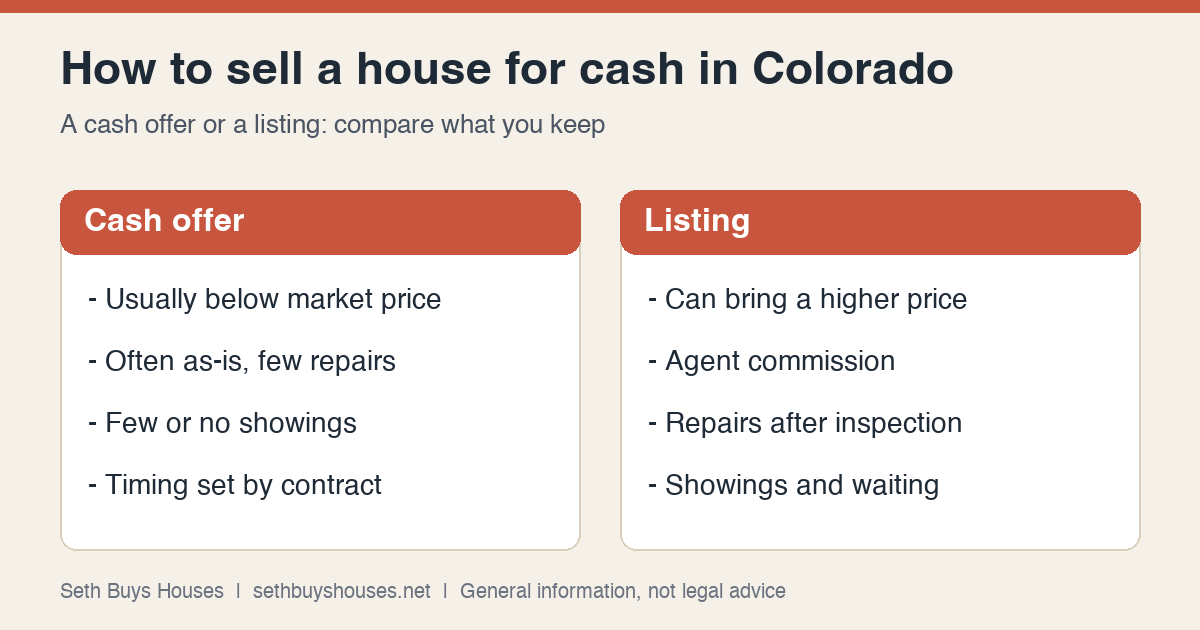
| Cash offer | Listing with an agent | |
|---|---|---|
| Price | Usually below what the house could bring on the market | Can be higher, and is set by what buyers pay |
| Who pays the agent | Usually no listing commission, but check the contract | You pay the commission you agree to |
| Repairs | Usually sold as-is | Buyers often ask for repairs after an inspection |
| Showings | Few or none | Photos, showings and sometimes open houses |
| Timing | Often set by you and the buyer | Depends on the market and the buyer’s loan |
| Risk the sale falls apart | Lower with a cash buyer, but ask for proof of funds | Higher when the buyer needs a loan |
| Paperwork | Purchase contract, disclosures, title and closing | Listing contract, then the same |
“As-is” means you do not repair the house for the buyer. It does not erase what you must tell them. In Colorado you still owe the buyer written disclosures on things like radon, your water source and lead paint in older homes, plus anything you know about hidden defects. Our guide to selling a house as-is in Colorado walks through that, and the guide to selling without an agent lists the paperwork.
Compare what you keep, not the price
A bigger number is not always more money. These are the lines that decide what you keep, on either route:
- Sale price. The offer, or what you realistically expect a listing to bring.
- Agent commission. Whatever you were quoted for the listing. Ask for it in writing, and ask what the agent does for it.
- Repairs and prep. What the house needs to sell, whether you pay for it before or after.
- Carrying costs. Mortgage, taxes, insurance, utilities and any HOA dues for every month the house is unsold. A longer sale means more months.
- Closing costs. Title and escrow charges and the Colorado documentary fee (C.R.S. 39-13-102). Who pays which items is part of the contract, so ask.
- Loan payoff and liens. What you owe comes out of the proceeds either way.
Fill in both columns of the worksheet and the comparison usually becomes clear. The worksheet has blanks, not numbers, because yours are not ours.
Download the cash vs. listing net-proceeds worksheet (PDF)
A worked example with made-up numbers
These figures are invented round numbers to show the method. They are not market data and not a prediction for your house.
Say a house could sell for $400,000 on the market. A made-up agent fee and closing costs total $24,000. Case 1 needs $8,000 of repairs and sits for four months at $2,000 a month in carrying costs. A cash buyer offers $350,000, with $1,500 of closing costs and one month of carrying costs.
| Listing, case 1 | Listing, case 2 | Cash offer | |
|---|---|---|---|
| Sale price | $400,000 | $400,000 | $350,000 |
| Agent fee and closing costs | $24,000 | $24,000 | $1,500 |
| Repairs | $8,000 | $30,000 | $0 |
| Carrying costs | $8,000 | $16,000 | $2,000 |
| You keep | $360,000 | $330,000 | $346,500 |
In case 1 the listing keeps $13,500 more. In case 2 the house needs $30,000 of repairs and takes eight months, and the cash offer keeps $16,500 more. Same house, same cash offer; only the repairs and the wait changed. That is why the worksheet is worth ten minutes.
Which route fits which situation
A cash offer tends to fit when:
- You need to move by a date, or you need to stop paying on a house you do not live in.
- The house needs work you cannot afford or do not want to manage.
- The home is inherited, in probate or has tenants, and the time and effort are the real cost. See selling an inherited house and selling in probate.
- You want fewer moving parts: no showings, no staging, no loan to fall through.
A listing tends to fit when:
- The house is in good shape and you can wait for the market.
- Getting the highest price matters more than speed.
- You want an agent to handle pricing, marketing and negotiation.
If you are behind on payments or have received foreclosure papers, you may have deadlines. Read about avoiding foreclosure and talk to a housing counselor or attorney soon.
What to check with any cash buyer
Most cash buyers are honest, and the checks are the same for everyone. Before you sign:
- Ask for proof of funds or how the buyer will pay, in writing.
- Read who is on the contract. Some buyers sign a contract and then assign it to another buyer. If so, you should know who actually closes and whether your price depends on that.
- Look at the earnest money. How much, who holds it, and when you could lose or keep it if the deal fails.
- Check the closing date and contingencies. A cash contract can still be conditional. Ask what the buyer can walk away for.
- Ask who pays which closing costs and see the numbers on a settlement statement before closing day.
- Do not feel rushed. A real offer is still real tomorrow. A buyer who pushes you to sign today without reading is a reason to slow down.
- Use a title company or attorney to handle the closing, so funds and title change hands in the open.
Compare at least two offers if you can. Our cash offer form is one place to start: request a no-obligation cash offer.
Other routes worth knowing
- List with an agent who also markets to cash buyers. Some agents attract investor offers while the house is listed (HomeLight describes this).
- A listing with fewer services. Some brokers offer a flat fee or a reduced service level. Ask exactly what is and is not included.
- Sell it yourself. See selling without an agent.
These sit between the two routes above, and the worksheet works for each.
Colorado things to check
- Disclosures still apply. Cash or listing, as-is or repaired, you owe the buyer the required Colorado disclosures and anything you know about hidden defects. A Colorado Bar publication explains why “as is” does not cover a defect you knew about (Colorado Lawyer).
- Get any commission quote in writing and compare it on the worksheet before you choose.
- Ask your title company or attorney about the contract, who pays which costs and what happens if the buyer backs out.
- Taxes and your loan depend on your situation. A tax professional can tell you what applies to you.
Common questions
Is a cash offer always lower than a listing?
Not always, and it is usually lower on the headline price. What you keep depends on commission, repairs, carrying costs and closing costs, which is what the worksheet compares.
How fast can a cash sale close?
It depends on the buyer, the title work and the contract. Do not rely on a promise; ask for the proposed closing date in writing.
Do I have to make repairs for a cash buyer?
Many cash buyers buy as-is, so you do not repair the house for them. You still disclose what you know. Say what is wrong up front, because a surprise at inspection can change the price.
Do I pay closing costs on a cash sale?
Some of them, yes. Who pays which items is set in the contract. Ask for the list before you sign.
Is a cash buyer safe?
Most are legitimate. Check proof of funds, read the contract, use a title company, and do not sign under pressure.
Can I get a cash offer and still list?
Yes. A no-obligation offer commits you to nothing. You can compare it with a listing, then choose.
What if my house has liens or I owe more than it is worth?
The payoff comes out of the proceeds either way. If the offer is below what you owe, talk to your lender and an attorney about options before you accept.
Where to start this week
- Write down what you owe and what you would need to net.
- Download the worksheet and fill in the listing column with a commission quote and a repair estimate.
- Get at least one cash offer and one agent’s opinion of value, and put both on the worksheet.
- Read any contract in full, and have a title company or attorney look at it.
- Choose the route that keeps more of what you need, on the timeline you can live with.
