
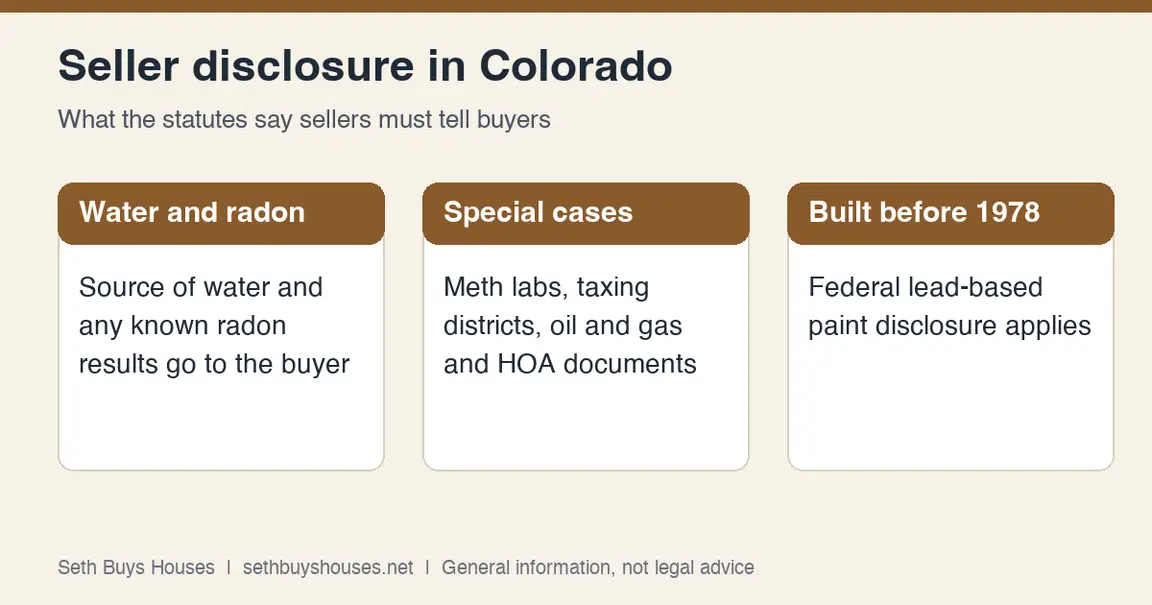
Short answer: seller disclosure in Colorado is a set of written statements a seller gives a buyer about the property. Colorado’s statutes require specific disclosures, including the source of potable water, any known methamphetamine lab use, radon information the seller knows, special taxing districts, common interest community obligations and oil and gas activity. For homes built before 1978, a separate federal rule requires lead-based paint disclosure. Brokers use a Colorado Real Estate Commission form, the Seller’s Property Disclosure, to collect many of these. Read the statutes below, gather what you know and ask your agent or attorney how to complete the form.
General information only, not legal advice. Disclosure duties depend on your property and your sale. Ask a Colorado attorney or your listing agent before you complete or sign any disclosure.
In this guide
- What seller disclosure means
- The Colorado statutes that require disclosures
- Lead-based paint, for homes built before 1978
- The Commission’s Seller’s Property Disclosure form
- What if you do not know?
- What to gather before you complete it
- Where selling fits
- Common questions
- Where to start this week
What seller disclosure means
A seller disclosure is information the seller provides to the buyer in writing, either in the sales contract, in a standalone statement or on a form. Some pieces are required by statute. Others are collected on a form that real estate brokers use. The rules cover things a buyer cannot easily see, such as where the water comes from, what is known about radon or whether the property may be affected by a special taxing district.
If you are selling as-is, disclosure is a separate topic from repairs. Our as-is guide covers pricing and condition, and this guide covers what you tell the buyer.
The Colorado statutes that require disclosures
Colorado’s disclosure statutes are in article 35.7 of title 38. I read the following sections on colorado.public.law, which reproduces the statutes. For each, the duty is on the seller.
| Topic | What the statute says | Section |
|---|---|---|
| Special taxing districts | Every contract for the sale of residential property must include a disclosure statement in bold, clearly legible type about special taxing districts that may have general obligation debt paid through property tax levies. If the seller fails to provide it, the purchaser has a claim for all damages plus court costs. | 38-35.7-101 |
| Common interest communities | A sales contract for residential property in a common interest community must include a bold disclosure statement. On request, the seller must provide the community’s governing and financial documents or authorize the association to do so. A purchaser may recover actual damages from a failure, and it is an affirmative defense that the purchaser knew the facts. | 38-35.7-102 |
| Methamphetamine labs | The seller must disclose in writing whether the seller knows the property was previously used as a methamphetamine laboratory, at or before the time of sale. A seller who knew and failed to disclose is liable for remediation costs and certain other costs, and the buyer must sue within three years after closing. A seller who remediates and receives the required certificates need not disclose. | 38-35.7-103 |
| Source of potable water | The disclosure states whether the source of potable water is a well, a water provider or neither. If a well, the seller must also supply the current well permit if one exists. | 38-35.7-104 |
| Transportation projects | The Real Estate Commission must require sellers to disclose the existence of any proposed or existing transportation project that affects or is expected to affect the property, through the seller’s property disclosure. | 38-35.7-105 |
| Oil and gas activity | The contract or seller’s property disclosure must carry a statement that the surface estate may be owned separately from the underlying mineral estate, covering third-party access and possible oil and gas activity. The section says it creates no duty to investigate or disclose that does not otherwise exist. | 38-35.7-108 |
| Metropolitan district website | For residences in a metropolitan district organized on or after January 1, 2000, the seller gives the buyer the district’s official website, for sales on or after January 1, 2024, through the seller’s property disclosure or another concurrent writing. | 38-35.7-111 |
| Elevated radon | The seller must give the buyer any known information on radon test results. The contract carries a bold statement that the Colorado Department of Public Health and Environment strongly recommends that all home buyers have an indoor radon test, and the seller’s contract or disclosure must cover what the seller knows about radon levels, testing and any mitigation, plus a copy of the state’s most recent radon brochure. | 38-35.7-112 |
Colorado’s Division of Real Estate also lists radon disclosure forms for buyers and tenants, prepared by the Colorado Bar Association under SB23-206, on its forms page (Colorado Division of Real Estate, Contracts and Forms).
Article 35.7 also includes sections on solar, water-smart homes, electric vehicle options and estimated future property taxes for new residences in metropolitan districts. I did not read those, so they are not covered here. Statutes change, so check the current text.
Lead-based paint, for homes built before 1978
Federal law adds a requirement for housing built before 1978. The EPA says sellers must disclose any known information about the presence of lead-based paint, provide available lead-related records and reports, give buyers the EPA pamphlet “Protect Your Family From Lead In Your Home,” include a Lead Warning Statement in the contract or as an attachment, give buyers a 10-day period to conduct a paint inspection or risk assessment (which the parties can change in writing and the buyer can waive) and keep a signed copy of the disclosures for three years after the sale (EPA, Real estate disclosure). The EPA says sellers who fail to provide the proper information may be subject to penalties.
The Commission’s Seller’s Property Disclosure form
The Colorado Real Estate Commission approves a Seller’s Property Disclosure form for residential sales. The Division of Real Estate’s forms page lists a version for use on and after January 1, 2026, and notes that updated Commission-approved contracts and forms for use on and after January 1, 2027 are posted for educational purposes, so the form in use can change from year to year (Colorado Division of Real Estate, Contracts and Forms). Several statutes above refer to the seller’s property disclosure as the place where required items are made.
I could not read the text of the form itself, because the Division’s PDF would not load in the tools I used. So this guide does not list the form’s questions or say how to answer them. When you complete it, use the current form from your agent or the Division, answer from what you actually know and ask your attorney about any question that is unclear.
What if you do not know?
Many sellers inherit a house, or have never tested for radon or checked the water permit. A few steps help:
- Answer from your own knowledge. The statutes above speak in terms of what the seller knows, such as “whether the seller knows” about a lab or “any known information” on radon.
- Gather records. Past inspection reports, a well permit, HOA documents and radon test results turn “I think” into “here is the document.”
- Do not guess. If you do not know, say so on the form instead of filling in an answer you cannot back up.
- Ask who can tell you. Your title company can pull the recorded documents. A prior owner, a neighbor or an HOA manager may fill in the history.
If you inherited the house, our guides on selling an inherited house in Colorado and selling in probate explain what a personal representative knows and does not know.
What to gather before you complete it
- The deed, title commitment and any survey.
- Any inspection, radon, sewer or well reports, and any warranty or repair records.
- HOA or metropolitan district documents and contact details.
- The well permit, if the house uses a well.
- For a pre-1978 home, any known lead-based paint records.
- Notices from the city, county or utilities about the property.
The one-page worksheet lines these up with blanks for your own answers:
Download the seller disclosure prep worksheet (PDF)
Where selling fits
Disclosure applies to every kind of sale, so gather your facts first and then compare how you want to sell. You can list with an agent, sell without one, sell as-is or ask for a no-obligation cash offer. Our guides compare them: selling without an agent, selling as-is and cash offer vs. listing. If you want to see what an offer looks like, you can request a no-obligation cash offer. We also have pages for homeowners in Fort Collins and Loveland.
Common questions
What do sellers have to disclose in Colorado?
By statute, items such as special taxing districts, common interest community obligations, methamphetamine lab use the seller knows about, the source of potable water, transportation projects, oil and gas activity, a metropolitan district website for certain homes and radon information the seller knows. Federal law adds lead-based paint for homes built before 1978.
Is the Seller’s Property Disclosure required by law?
Several statutes call for disclosures “through” the seller’s property disclosure or the contract. I could not read the form or the rule that governs when it is used, so ask your agent or attorney whether it applies to your sale.
Do I have to disclose radon?
The statute says sellers must provide any known information on radon test results and meet the contract statement and brochure requirements. If you have never tested, say that.
What if I do not know the answer to a question?
Answer from what you know, say you do not know where that is true and gather records that can fill the gap. Ask your attorney about anything unclear.
Does selling as-is change what I disclose?
I did not read a source that says it does. Treat disclosure as separate from price and repairs, and ask your attorney.
What happens if a seller fails to disclose?
It depends on the statute. For example, the statutes give a purchaser a claim for damages if the special taxing district or common interest disclosure is not provided, and a methamphetamine lab nondisclosure can make the seller liable for remediation costs. Ask an attorney about your situation.
Do I need to disclose lead paint on a 1975 house?
Federal rules apply to housing built before 1978. The EPA lists what sellers must provide, including the pamphlet, the warning statement and the 10-day inspection opportunity.
Where to start this week
- Get the current Seller’s Property Disclosure form from your agent or the Division of Real Estate.
- Gather inspection, radon, well, HOA and repair records.
- Write down what you actually know for each topic above, and what you do not.
- If the house was built before 1978, find any lead-related records.
- Ask a Colorado attorney or your listing agent to review the form before you sign.
