
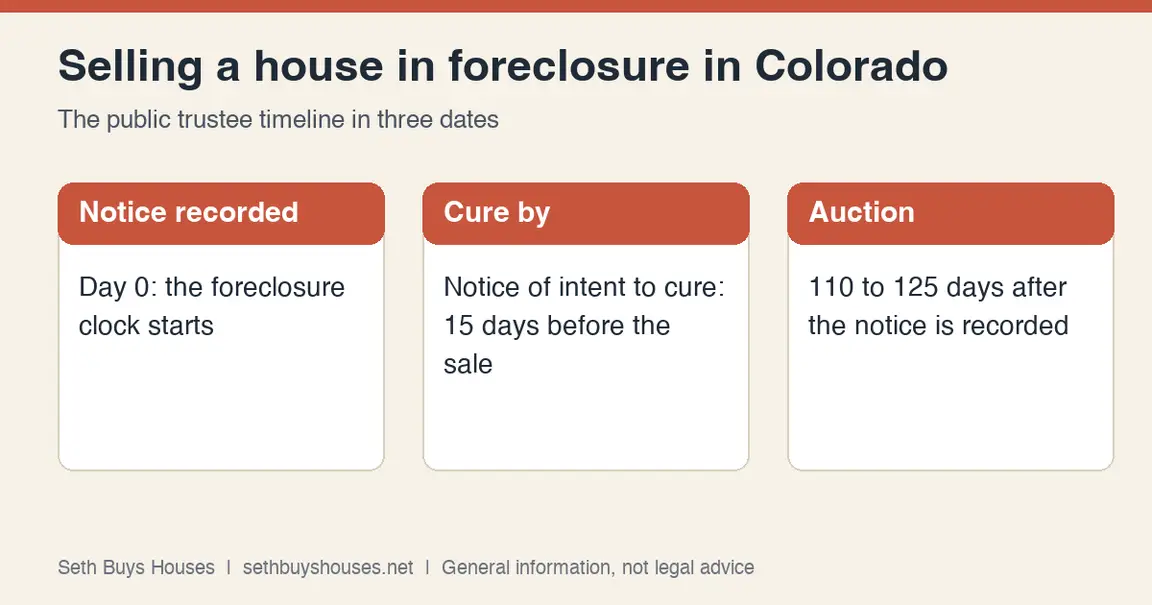
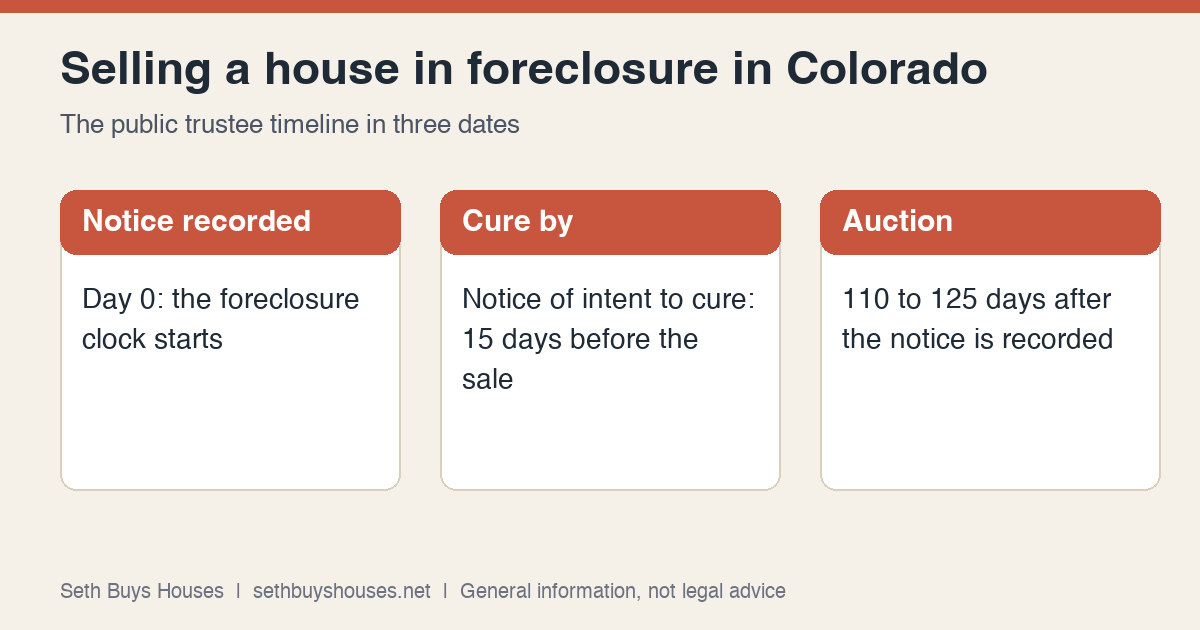
Short answer: selling a house in foreclosure in Colorado is generally possible, and the date that matters is the public trustee’s auction. Colorado foreclosures run through the county public trustee. For non-agricultural property the sale is set 110 to 125 days after the lender’s notice is recorded, and the owner can file a notice of intent to cure up to 15 days before the sale. A short sale, a deed in lieu, a regular sale or paying the loan current are different paths with different results. Because someone may offer to buy a house that is in foreclosure, Colorado also has a law that gives sellers a right to cancel in some of those deals. Get the dates from your own notices before you decide.
General information only, not legal advice. Foreclosure rules change and depend on your loan and your county. For your own situation, ask a Colorado attorney, a HUD-approved housing counselor or your county public trustee.
In this guide
- How foreclosure works in Colorado
- The timeline and the dates that matter
- Can you sell a house in foreclosure?
- Your options compared
- Warning signs and the Colorado Foreclosure Protection Act
- What to gather and what to ask
- Where selling fits
- Common questions
- Where to start this week
How foreclosure works in Colorado
Most Colorado foreclosures are handled outside a courtroom through the county public trustee. Every county has one, and in Denver the Clerk and Recorder is also the Public Trustee (Denver Public Trustee foreclosure guide).
The formal process starts when the lender’s attorney files the loan papers and a Notice of Election and Demand with the public trustee. Denver’s guide says the date the notice is recorded is the start date for the foreclosure. The public trustee must record it within ten business days after receiving the documents from the lender’s attorney (Adams County Public Trustee).
After that, notices go to the owner and to others with a recorded interest in the property. The public trustee then sells the property at a public auction to the highest bidder.
The timeline and the dates that matter
These are the rules the public trustees describe for non-agricultural property. Agricultural property has a longer window. Your own notices control, so read them first.
| Step | What the public trustee sources say |
|---|---|
| Notice of Election and Demand recorded | Within 10 business days after the public trustee receives the lender’s documents |
| First combined notice | Mailed within 20 calendar days of recording; tells the owner about the right to cure and the sale date |
| Auction | Not less than 110 and not more than 125 calendar days after the notice is recorded |
| Second combined notice | Mailed between 45 and 60 days before the first scheduled sale date |
| Notice of intent to cure | Must be filed no later than 15 calendar days before the sale (C.R.S. 38-38-104) |
| Paying the cure amount | Must be paid to the public trustee by 12 noon on the day before the sale |
Sources: Adams County Public Trustee, the Denver Public Trustee guide and C.R.S. 38-38-104.
Here is a made-up example to show how the dates stack. These are invented day counts, not your dates. Say the notice is recorded on day 0 and the auction is set for day 120. The first combined notice would be mailed by day 20. The second would come between day 60 and day 75. A notice of intent to cure would be due by day 105, and the cure amount by noon on day 119.
Two more details from the sources:
- Sales can move. Adams County says that if a sale is continued, the deadline to file a notice of intent to cure may also be extended. A sale can also be withdrawn. Denver’s guide defines a withdrawal as closing the foreclosure before the auction.
- Bankruptcy can pause it. Denver’s guide says that filing for bankruptcy pauses or restarts the foreclosure process, depending on the details. Ask a bankruptcy attorney before you rely on that.
Auction days differ by county. Denver says its auctions are held weekly online on Thursdays. Adams County says its regular sale is on Wednesdays at 10:00.
Can you sell a house in foreclosure?
Generally yes, and the auction date is the working deadline. The Colorado Foreclosure Protection Act itself speaks about “the sale and purchase of homes in foreclosure,” so a sale during foreclosure is something the law expects to happen (Colorado Division of Real Estate).
What a sale has to accomplish depends on the numbers:
- The price covers what you owe. The loan, back payments, fees and other liens are paid from the sale, and anything left is yours. A title company will order the payoff figures.
- The price is less than you owe. Then you are in short sale territory, and the lender has to agree. The CFPB defines a short sale as “a sale of your home for less than what you owe on your mortgage” (CFPB mortgage glossary).
- The house sells at the auction for more than is owed. Adams County says that if the property sells for more than the lender and other lienholders are owed, the owner should contact the public trustee after the sale because funds may be due.
A buyer needs time to close, so the days left before the sale matter. That is one reason to learn your dates early.
Your options compared
| Option | What it is | Main trade-off |
|---|---|---|
| Cure | Pay the past-due amount so the foreclosure stops. Denver’s guide says curing a loan stops the foreclosure process. | You must come up with the full cure amount by the deadline |
| Regular sale | Sell the house for enough to pay the loan and costs | You need enough time and enough equity |
| Short sale | Sell for less than you owe, with the lender’s approval | The CFPB says that because it is a sale, you will have to leave your home |
| Deed in lieu | You voluntarily turn over ownership to the lender to avoid foreclosure (CFPB) | The CFPB advises talking to an attorney if foreclosure is imminent or you have been served |
| Loan help | Modification, repayment plan or forbearance from your servicer | Your servicer decides what it offers, and the timeline keeps running |
The CFPB also describes a deficiency as the difference between the value of the property and what you still owe on the loan. Ask your lender, in writing, what happens to any remaining balance in a short sale or deed in lieu, and ask an attorney what Colorado law says before you sign (CFPB options page).
Our guides on selling as-is and cash offer vs. listing explain how to compare a sale price against what you would keep.
Warning signs and the Colorado Foreclosure Protection Act
Homeowners in foreclosure often hear from people who want to buy the house or “help.” Colorado has a law for that. The Colorado Foreclosure Protection Act was created in 2006 to curb deceptive practices aimed at people in financial distress, and it covers “equity purchasers” and “foreclosure consultants” (Colorado Division of Real Estate).
What the Division of Real Estate’s advisory says about it:
- A foreclosure consultant is someone who, for pay, says they will stop or postpone a foreclosure sale, get a forbearance or help you cure a default. The Act sets duties for them.
- An equity purchaser is generally someone who acquires title to a residence in foreclosure, with listed exceptions. One exception is a person who buys it to live in it as their own residence.
- A right to cancel. When the Act’s contract applies, the seller can cancel without penalty until the earlier of midnight on the third business day after signing or noon on the day before the foreclosure sale.
- Required forms. A notice of cancellation and warning notices must be attached. One warns the seller that the buyer will not assume the mortgage, so the seller stays responsible for it and for any deficiency.
- Penalties. The advisory lists criminal penalties and a fine up to $25,000 and/or one year in jail, and deceptive trade practice liability with triple damages for bad faith.
The CFPB gives general red flags too. Be wary of any company that guarantees it will change your mortgage terms, and of requests to sign over title to your home or to sign documents you do not understand (CFPB options page).
Whether the Act applies to a particular sale is a legal question for a Colorado attorney. The advisory’s form lists the Colorado Foreclosure Hotline, 1-877-601-4673, for a housing counselor.
What to gather and what to ask
Collect these before you talk to any buyer, lender or agent:
- Every notice from the public trustee, your lender and the lender’s attorney, with dates.
- The date the notice was recorded and the scheduled sale date. Your public trustee’s office can confirm both.
- Your most recent loan statement and a payoff figure from your servicer.
- A list of other liens, such as a second mortgage, HOA dues or unpaid property taxes.
- A rough value for the house from an agent’s opinion or an appraisal.
Questions worth asking:
- What is the exact sale date, and has it been continued?
- What is the cure amount, and when is the notice of intent to cure due?
- Would the servicer approve a short sale, and how long does approval take?
- If a buyer offers, what is the cancellation deadline in writing, and does the contract follow the Foreclosure Protection Act?
The one-page worksheet pulls the dates and numbers into one place:
Download the foreclosure deadlines and sale options worksheet (PDF)
Where selling fits
Once you have your dates and numbers, the sale choice is a net-proceeds question. You can list with an agent, sell without one, sell as-is or ask for a no-obligation cash offer. Our guides compare these: selling without an agent, selling as-is and cash offer vs. listing. If you want to see what an offer looks like, you can request a no-obligation cash offer. We also have pages for homeowners in Fort Collins and Loveland, and our avoiding foreclosure page covers more options.
Whoever you talk to, ask for any offer and any contract in writing, read the cancellation terms, and take your time to compare before the cancellation window closes.
Common questions
Can you sell a house in foreclosure in Colorado?
Generally yes. The practical deadline is the public trustee’s auction, so your timeline depends on the sale date in your notices. Whether the sale covers the loan decides whether you need the lender’s approval.
How long do you have before a Colorado foreclosure sale?
For non-agricultural property, the sale is set not less than 110 and not more than 125 calendar days after the notice of election and demand is recorded, per the public trustee sources above. Sales can be continued, so confirm your date.
What is a notice of intent to cure?
It is a written notice that an eligible person files with the public trustee to cure the default. It must be filed no later than 15 calendar days before the sale. The cure amount must be paid by noon the day before the sale.
What is the difference between a short sale and a deed in lieu?
In a short sale you sell the house for less than you owe, with the lender’s approval. In a deed in lieu you voluntarily turn the property over to the lender. The CFPB describes both as alternatives to foreclosure.
Does the Colorado Foreclosure Protection Act give me a right to cancel?
When its contract applies, the seller can cancel until the earlier of midnight on the third business day after signing or noon on the day before the foreclosure sale, according to the Division of Real Estate. Ask an attorney whether it applies to your deal.
Where can I get free help?
The Division of Real Estate’s advisory lists the Colorado Foreclosure Hotline at 1-877-601-4673. The Colorado Division of Housing lists 2-1-1 Colorado and the CARE center, and recommends Colorado Housing Connects (Division of Housing).
What if I miss the sale date?
If the property sells at the auction, the foreclosure sale has happened. Adams County says owners should contact the public trustee after a sale if the property sold for more than was owed, because funds may be due. Ask an attorney about anything else that follows.
Where to start this week
- Read every notice and write down the recording date and the sale date.
- Call your county public trustee to confirm both dates.
- Call the Colorado Foreclosure Hotline or a HUD-approved counselor for free guidance.
- Get a payoff figure and a rough value, then fill in the worksheet.
- Before you sign anything with a buyer, ask a Colorado attorney whether the Foreclosure Protection Act applies and when you can cancel.
