
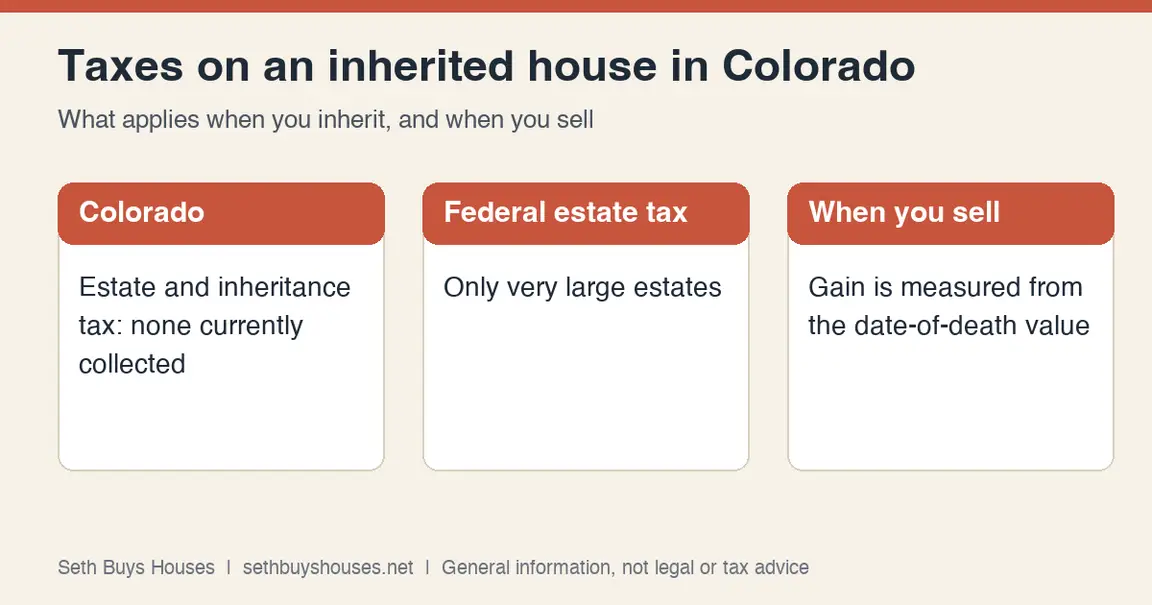
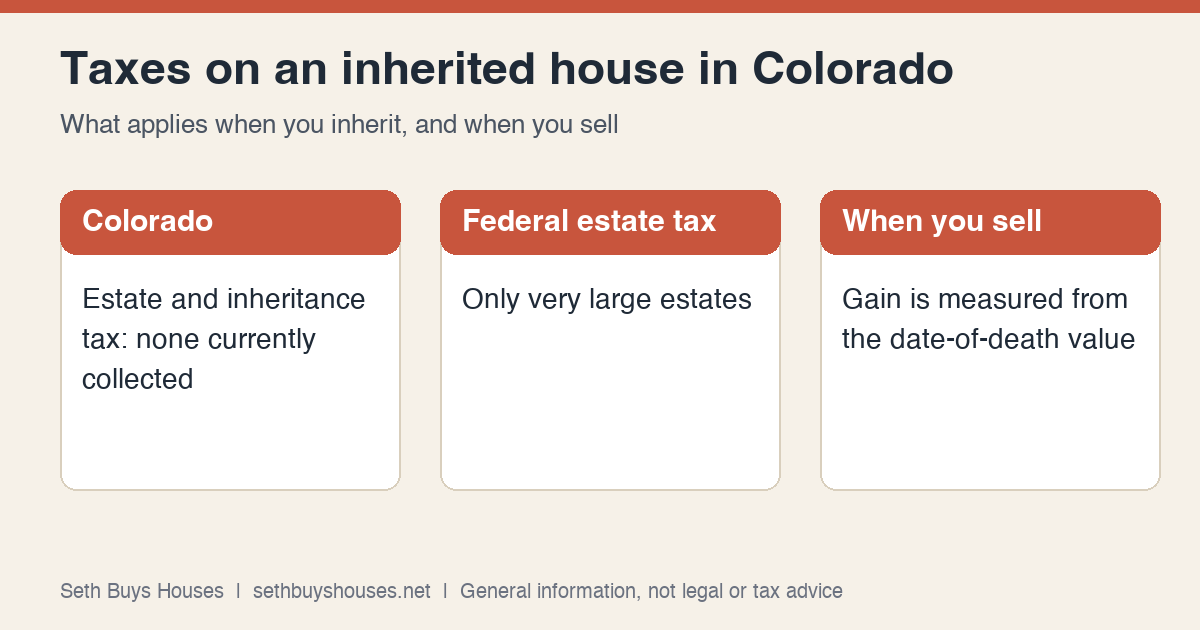
Short answer: for taxes on an inherited house in Colorado, the state does not currently collect an estate tax or an inheritance tax, so inheriting the house does not by itself create a state tax bill. The tax question usually comes later, when you sell. Under federal law, an heir’s tax basis in an inherited house is generally its fair market value on the date the owner died, not what the owner paid. That “step-up” often leaves little or no taxable gain when the house sells soon after for about that value. Federal estate tax applies only to very large estates. Your own numbers decide the rest, so check them with a tax professional.
General information only, not legal or tax advice. Tax rules and thresholds change. For questions about your own situation, ask a CPA, a tax attorney or the estate’s attorney before you sell.
In this guide
- Does Colorado have an estate or inheritance tax?
- Federal estate tax: does it reach your inheritance?
- Step-up basis: why the gain is often small
- Capital gains when you sell
- A worked example with made-up numbers
- Property taxes, the documentary fee and other costs
- What to gather before you sell
- Where selling fits
- Common questions
- Where to start this week
Does Colorado have an estate or inheritance tax?
Not in practice. The Colorado Legislative Council staff reports that Colorado “has not collected any estate taxes since FY 2013-14.” Its page explains that federal changes effectively eliminated the Colorado estate tax for people who die after December 31, 2004, and that no Colorado estate tax filing is required for those deaths (Colorado Legislative Council Staff).
The same page says Colorado replaced its old inheritance tax with an estate tax in 1980, so there is no separate inheritance tax in effect today. It also notes the estate tax could return if federal law reinstates the state death tax credit, so it is worth a quick check if the death was recent or the law has changed.
The practical point: the heir does not get a Colorado tax bill for receiving a house.
Federal estate tax: does it reach your inheritance?
The federal estate tax applies only when an estate is large. The IRS says a filing is required if the decedent’s gross estate, plus adjusted taxable gifts, is valued at more than the filing threshold for the year of death. Its table lists $15,000,000 for 2026 and $13,990,000 for 2025 (IRS estate tax).
Most Colorado families are well below that. If the estate may be near or over the threshold, the estate’s attorney or the personal representative should handle the filing. It is separate from the question of what you owe when you later sell the house.
Step-up basis: why the gain is often small
“Basis” is the starting value used to figure gain or loss when you sell. For inherited property, federal law sets the basis at the fair market value on the date of the decedent’s death, instead of what the owner originally paid (26 U.S.C. 1014). If the estate’s personal representative elects it, the basis can instead be the value on the alternate valuation date, which is why the law refers to section 2032. The IRS explains the same rule for inherited property in Publication 551.
What that means for you:
- If the owner bought the house decades ago for far less, you generally do not owe tax on that old appreciation. Your basis starts at the date-of-death value.
- Your gain is measured from that value to the price you sell for. If the house sells for about the same, the gain is small.
- The value should be documented. A date-of-death appraisal is the usual way, and it is worth getting before you sell or make changes.
- If the estate had to file a federal estate tax return, you may receive a Schedule A (Form 8971) showing the basis. Keep it (IRS Publication 544).
The rules can differ for property held in certain trusts or by spouses who owned it jointly, so ask a tax professional how they apply.
Capital gains when you sell
A gain is the sale price minus your basis, after the costs your tax preparer says you may subtract. Whether it is taxed as long-term or short-term depends on how long the asset was held. The IRS says a gain is long-term if you hold the asset more than one year (IRS Topic 409).
For inherited property there is a special rule. If your basis comes from the date-of-death value and you sell the property within one year after the decedent’s death, the law treats you as having held it for more than one year (26 U.S.C. 1223). In plain terms, a quick sale after inheriting is generally treated as long-term, not short-term.
Two more points:
- The home-sale exclusion usually does not help heirs who never lived there. The IRS says you may exclude up to $250,000 of gain ($500,000 on a joint return) if you owned the home and used it as your residence for at least 24 months of the previous 5 years (IRS Topic 701). Many heirs have not lived in the house, so they cannot use it. If you did live there, ask a tax professional.
- Colorado taxes income at a flat rate, and gains are generally part of that income. Check the current rate and your return rules on the Colorado Department of Revenue site, or ask your preparer.
A worked example with made-up numbers
These figures are invented round numbers to show the method. They are not market data and not a prediction for your house.
Say the owner bought a house long ago for $90,000. The date-of-death appraisal says it was worth $400,000. An heir sells it for $410,000.
| With step-up basis (the rule) | If the old price were the basis | |
|---|---|---|
| Sale price | $410,000 | $410,000 |
| Basis | $400,000 | $90,000 |
| Gain | $10,000 | $320,000 |
The second column is only there to show why the step-up matters. It is not how inherited property is taxed. In this made-up case the taxable gain is $10,000, not $320,000, because the basis resets at the date-of-death value. If the house sat for years and rose to $480,000, the gain would be larger, because the appreciation after the date of death is yours.
Property taxes, the documentary fee and other costs
Selling an inherited house has costs that are not income tax:
- Property taxes. They keep coming due while the house sits. Ask the county treasurer what is owed and when. Unpaid taxes usually have to be settled at closing, so a title company will look for them.
- The documentary fee. Colorado has no general state transfer tax. It charges a documentary fee of 1 cent per $100 of the price when the price is over $500, with the details in the statute (C.R.S. 39-13-102). Some cities have their own local taxes, so ask your title company.
- Carrying costs. Insurance, utilities, upkeep and mortgage payments if there is a loan. Our worksheets in the guides on selling for cash and selling without an agent help you line these up against a sale price.
- Rental income. If the house earns rent before you sell, that income is taxable and is a separate topic for your preparer.
What to gather before you sell
- The date of death and the death certificate.
- A date-of-death appraisal or another written valuation your tax professional accepts.
- Any Schedule A (Form 8971) or estate tax return papers, if the estate filed one.
- The deed, the loan statement and the latest property tax bill.
- Receipts for repairs and improvements, and the estate’s records of expenses.
- Who the personal representative is and whether probate is open. Our guides cover selling an inherited house and selling in probate.
The one-page worksheet pulls these together with blanks for your own figures:
Download the inherited house basis and gain worksheet (PDF)
Where selling fits
Once you know the likely tax, the sale choice is a net-proceeds question. You can sell as-is, list with an agent, or ask for a no-obligation cash offer. Our guides compare them: selling as-is, cash offer vs. listing and selling without an agent. If you want a quick number, you can request a no-obligation cash offer.
Timing matters for taxes and for costs. Selling within a year of the date of death is generally treated as long-term, as above, and every month the house sits adds carrying costs. Ask your tax professional how that trades off for your case.
Common questions
Do I pay tax when I inherit a house in Colorado?
Colorado does not currently collect an estate tax or an inheritance tax, so receiving the house does not create a state tax bill. A tax question can come up when you sell.
Do I pay capital gains tax on an inherited house?
Only on gain above your basis, and for inherited property the basis is generally the fair market value on the date of death. If you sell for about that value, the gain is usually small.
What is a step-up in basis?
It is the reset of the starting value to the fair market value at the date of death. It means the owner’s old purchase price generally does not decide your gain.
Do I have to live in the house to avoid tax?
No. Many heirs who sell soon after inheriting, for about the date-of-death value, owe little or no federal income tax on the sale because of the step-up. The home-sale exclusion is a separate rule that generally requires you to have lived in the home.
Does federal estate tax apply to my inheritance?
Only if the estate is large. The IRS lists a $15,000,000 filing threshold for 2026 deaths. The estate’s attorney handles that.
Who files the returns?
The personal representative handles the decedent’s final returns and any estate returns. You report your own sale on your own return. A CPA or tax attorney can confirm what applies.
What if the house is worth less than the date-of-death value when I sell?
Then you may have a loss rather than a gain, and how a loss is treated depends on whether the property is personal use or held for rent or investment. A tax professional can tell you.
Where to start this week
- Find the date of death and get a date-of-death appraisal if there is none.
- Ask the estate’s attorney or personal representative whether a federal estate tax return was or must be filed.
- Gather the papers above and fill in the worksheet.
- Ask a CPA or tax attorney to run your numbers before you sign a contract.
- Get a cash offer and, if you want, an agent’s opinion of value, then compare what you would keep.
