
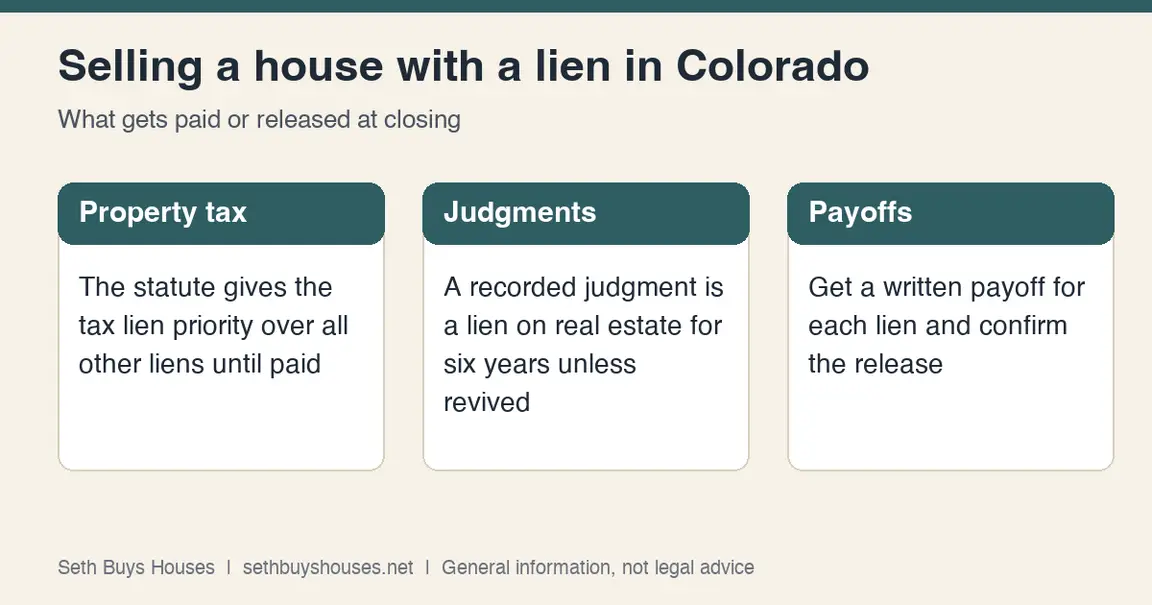
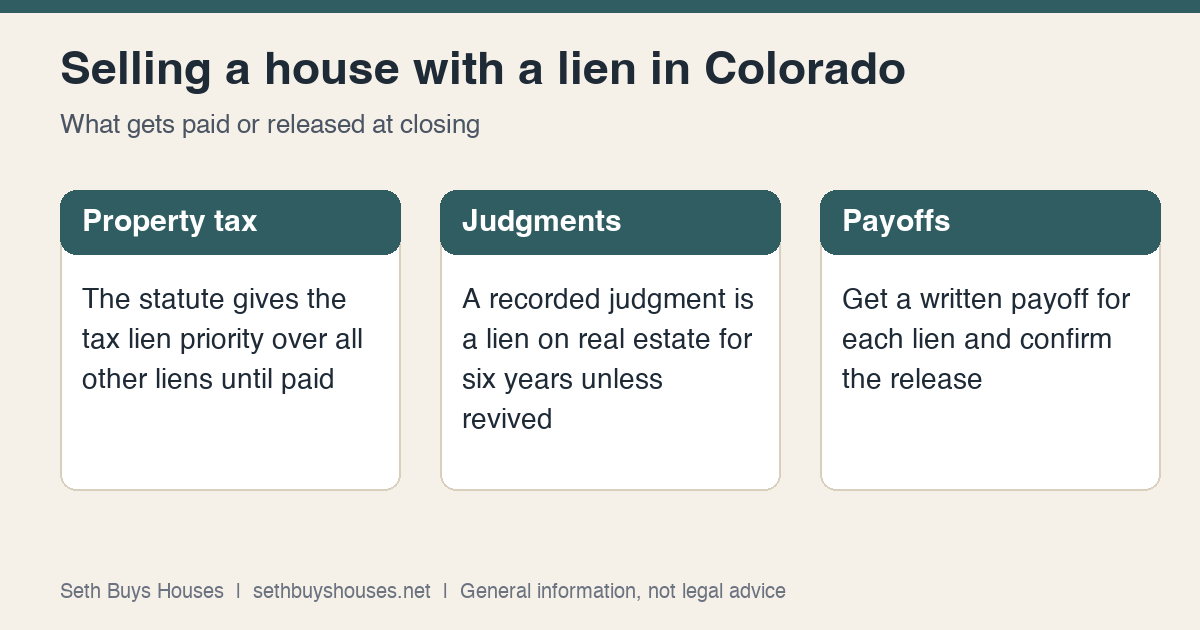
Short answer: selling a house with a lien in Colorado is generally possible, but a buyer and a title company will want each lien paid off or released at or before closing. Common liens are a mortgage or home equity loan, unpaid property taxes, a recorded court judgment and a federal tax lien. In Colorado, the statute says the lien for property taxes takes priority over all other liens until the taxes are paid, and a recorded judgment becomes a lien on real estate in that county for six years unless it is revived. The first step is to find every lien, get a written payoff for each and compare the total to what the house can sell for.
General information only, not legal advice. Lien law is detailed and depends on the type of lien and your county. Ask a Colorado attorney or your title company about the liens on your house.
In this guide
- What a lien is and how to find yours
- Unpaid property taxes
- Judgment, IRS and mortgage liens
- How payoffs work at closing
- Getting a lien released
- What to gather before you sell
- Where selling fits
- Common questions
- Where to start this week
What a lien is and how to find yours
A lien is a legal claim against a property for a debt. The IRS describes a federal tax lien as “the government’s legal claim against your property when you neglect or fail to pay a tax debt” (IRS, Understanding a federal tax lien). Other liens come from a loan secured by the house, an unpaid tax bill or a court judgment.
To find yours:
- Read your closing papers and recent mortgage and home equity statements.
- Look at your county treasurer’s property tax record for the parcel.
- Ask a title company to run a title search, which is how most sellers learn what is recorded against the house.
- Check any court judgments against you with an attorney, since a judgment lien depends on a recording.
Our guides on selling a house in foreclosure and selling in probate explain two situations where liens often come up.
Unpaid property taxes
Property taxes work differently from most liens, so they get their own section.
- The lien attaches automatically. The statute says the lien for current-year general taxes attaches to taxable property “at 12 noon on the assessment date.” Taxes with interest, costs and fees are “a perpetual lien” that “shall have priority over all other liens until such taxes” are paid in full (C.R.S. 39-1-107).
- Taxes can be paid in installments. A taxpayer may pay in full or in two equal installments, the first on or before the last day of February and the second no later than June 15. A single full payment avoids interest if made on or before the last day of April. Unpaid amounts accrue interest at one percent per month from the date the statute sets, so late taxes get more expensive every month (C.R.S. 39-10-104.5). Larimer County’s treasurer page lists the same pattern for 2026: first half February 28, second half June 15, full payment April 30, with no partial payments accepted (Larimer County Treasurer).
- Unpaid taxes can lead to a tax lien sale. County treasurers send notices by September 1 to owners with unpaid prior-year taxes, and the notice sets the date of a public auction at which the treasurer sells a tax lien on the property (C.R.S. 39-11-101). Larimer County’s page listed its 2026 annual tax lien sale for Thursday, November 19, 2026, at the Larimer County Fairgrounds in Loveland, and the date changes by year. A tax lien sale is not the same as selling the house, but it adds a third party to your payoff.
If you owe back taxes, ask the county treasurer for an exact payoff amount that includes interest, and ask your title company how it will be paid at closing. The figure changes monthly, so get it close to the closing date.
Judgment, IRS and mortgage liens
Judgment liens. Under Colorado law, a judgment becomes a lien on real estate in a county from the time a certified transcript of it is recorded there, and not before, on real estate that is not exempt from execution. The lien expires six years after entry of the judgment unless the judgment is revived, and it expires if the judgment is satisfied (C.R.S. 13-52-102). Ask your attorney whether a judgment against you was recorded in your county and what it would take to satisfy or release it.
Federal tax liens. The IRS page says a federal tax lien covers “all your property, including real estate,” and that a discharge “removes the lien from specific property.” It points to Publication 783 for instructions and lists a Centralized Lien Operation number, 800-913-6050, that can help you request a lien payoff amount or release. The page I read does not describe how a payoff works at closing, so ask a tax attorney or the IRS before you list.
Mortgages and home equity loans. These are liens too. The CFPB’s HELOC booklet says that if you sell your home, you are generally required to pay off your HELOC in full immediately (CFPB, What you should know about home equity lines of credit). A first mortgage is normally paid from the sale as well. Our as-is guide explains how to compare an offer against what you would keep after payoffs.
Other liens exist, such as contractor or HOA liens. I did not read the statutes for those, so they are not covered here.
How payoffs work at closing
At closing, the title company or closing agent generally collects the sale price from the buyer, pays off the liens that must be cleared and sends the rest to you. For a mortgage, federal regulations give you a way to get the number: a servicer must send a payoff statement within a reasonable time and in no case more than seven business days after receiving a written request from the consumer or someone acting for the consumer, with limited exceptions such as loans in foreclosure or bankruptcy and reverse mortgages (CFPB, Regulation Z section 1026.36).
A simple made-up example shows the math. These numbers are invented, not your numbers.
| Item | Amount |
|---|---|
| Sale price | $400,000 |
| Mortgage payoff | $250,000 |
| Home equity line payoff | $30,000 |
| Past-due property tax with interest | $6,000 |
| Recorded judgment payoff | $15,000 |
| Left before selling costs | $99,000 |
If the payoffs and costs add up to more than the price, you would need to bring money, negotiate with the lienholder or look at a short sale or other options. A lender’s approval is part of a short sale, and the CFPB says to ask for any deficiency waiver in writing (CFPB, What is a short sale?).
Getting a lien released
Payoff is only half of it. The lien has to come off the record. For a deed of trust, Colorado law has the public trustee release it on receipt of items that include a written request from the holder of the evidence of debt, the original canceled evidence of debt (or an alternative the statute allows) and the fees, and then record the release with the county clerk and recorder (C.R.S. 38-39-102). The statute I read does not set a day limit for the holder, so ask your lender how long it takes, and ask your title company to confirm the release after closing.
For tax liens and judgments, the release comes from the taxing agency or the court. Ask for a written release and make sure it is recorded when the deal requires it.
What to gather before you sell
- Your mortgage, home equity and any other loan statements.
- The county treasurer’s tax record and any delinquency notice.
- Any court papers, judgments or IRS notices about the house.
- A title search or title commitment, if you have one.
- Written payoff amounts for each lien, dated close to your closing date.
- A written opinion of value and an estimate of selling costs.
The one-page worksheet lines these up with blanks for your own figures:
Download the liens and payoff worksheet (PDF)
Where selling fits
Once you know the total of the payoffs, the sale choice is a net-proceeds question. You can list with an agent, sell without one, sell as-is or ask for a no-obligation cash offer. Our guides compare them: selling without an agent, selling as-is and cash offer vs. listing. If you want to see what an offer looks like with the liens in place, you can request a no-obligation cash offer. We also have pages for homeowners in Fort Collins and Loveland. Whichever route you pick, the liens still have to be paid or released through closing.
Common questions
Can you sell a house with a lien in Colorado?
Generally yes. The lien is usually paid from the sale proceeds at closing or released first. Buyers and title companies generally expect each lien to be dealt with before closing.
Can you sell a house with unpaid property taxes?
Yes, but the taxes are a lien that the statute says has priority over all other liens until paid. The back taxes, interest and fees are normally paid at closing. Ask the county treasurer for an exact payoff.
What happens if the lien is bigger than the sale price?
The sale would not cover everything. Options include bringing money to closing, negotiating with the lienholder or asking a lender about a short sale. Ask an attorney and get any waiver in writing.
How long does a judgment lien last in Colorado?
The statute says six years from entry of the judgment unless it is revived within that period, and it ends sooner if the judgment is satisfied.
Does a federal tax lien stop a sale?
It covers real estate you own. The IRS says a discharge removes the lien from specific property and points to Publication 783. Ask a tax attorney or the IRS how it fits your sale.
How long does a mortgage payoff statement take?
Federal regulation says a servicer must send it within a reasonable time and no more than seven business days after a written request, with limited exceptions.
Who clears the lien after closing?
The title company generally handles payoffs and asks for the releases. A deed of trust is released through the public trustee on the holder’s request, so confirm the recording.
Where to start this week
- Order a title search or ask a title company to list every recorded lien.
- Pull your county treasurer’s tax record and any delinquency notice.
- Ask each lienholder for a written payoff dated close to your target closing date.
- Fill in the worksheet and compare the total to a written opinion of value.
- Ask a Colorado attorney about any judgment, IRS or disputed lien before you list.
