
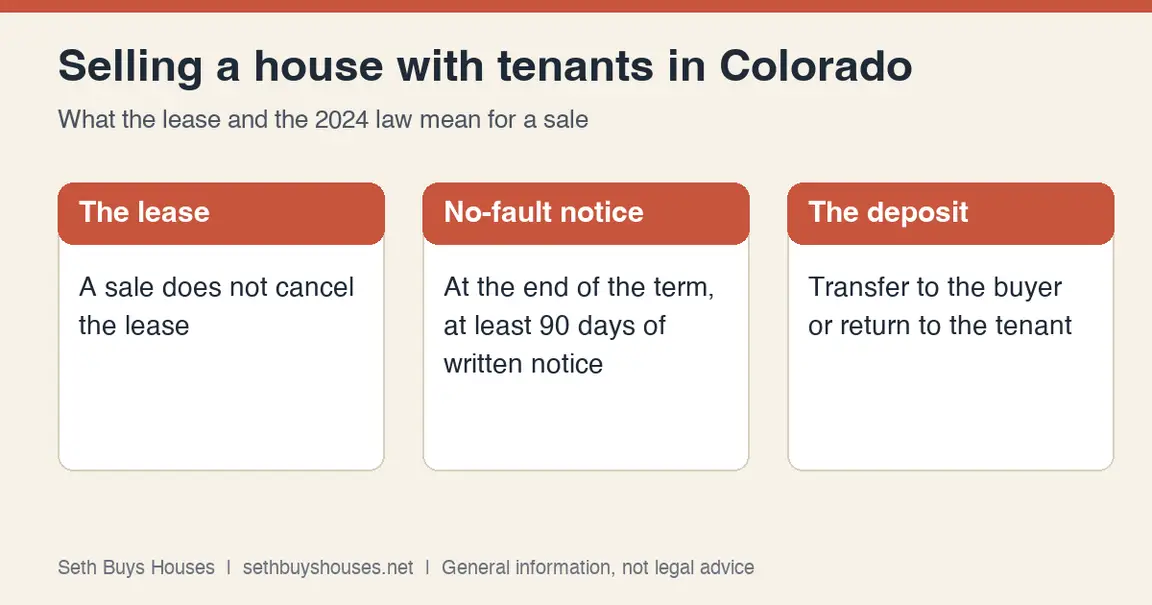
Short answer: selling a house with tenants in Colorado does not cancel the lease. Colorado’s 2024 law, House Bill 24-1098, requires cause to evict most residential tenants, and a landlord who wants to sell can use a “no-fault” route for a single-family home, townhome, duplex, triplex or individual condo unit. That route works only at the end of the lease term, and it requires at least 90 days of written notice. A tenant who is still in the lease when you sell generally stays, so many owners sell with the tenant in place or wait for the lease to end. Read your lease and the law before you list.
General information only, not legal advice. Landlord-tenant law changes and depends on your lease, your property type and your tenant’s history. Ask a Colorado attorney before you serve any notice.
In this guide
- What happens to a lease when the house sells
- The no-fault notice for a sale
- Option 1: sell with the tenant in place
- Option 2: sell after the tenant leaves
- The security deposit when ownership changes
- What to gather before you sell
- Where selling fits
- Common questions
- Where to start this week
What happens to a lease when the house sells
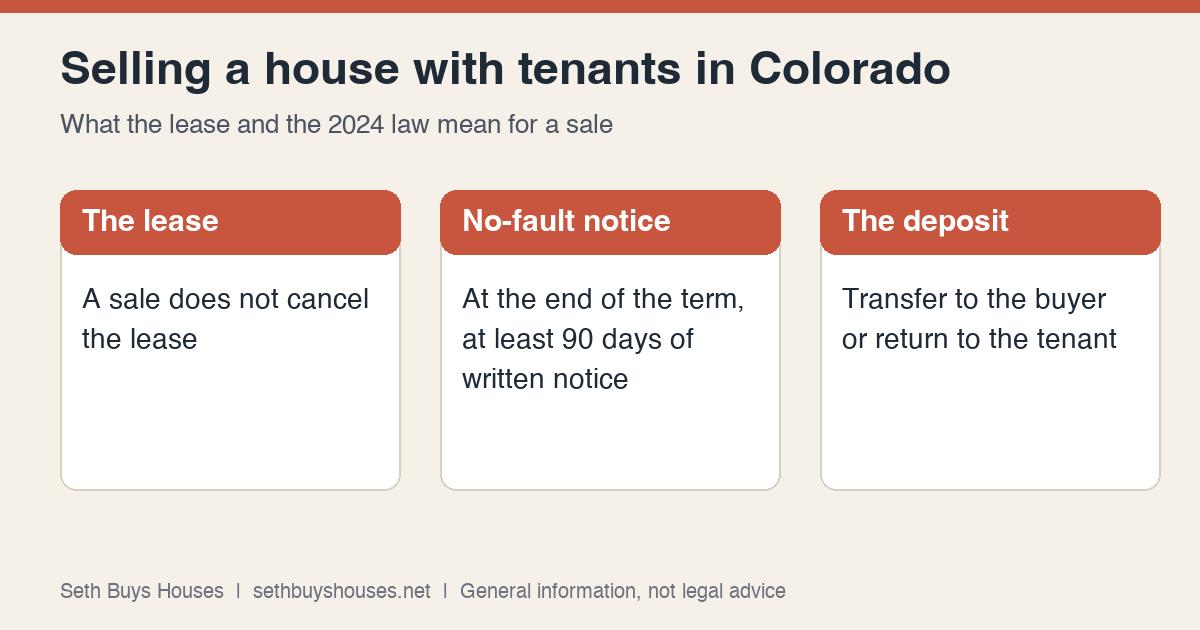
The sale does not end the lease. The Colorado statute on no-fault evictions says plainly that nothing in the sale provision lets a landlord end a rental agreement without cause before the end of its term (HB24-1098, final act text). In practice, a buyer who closes during a lease generally takes the house subject to that lease. Ask your attorney how it applies to your lease.
Two things follow from that:
- A fixed-term lease keeps running. If the lease ends in eight months, the tenant can stay through those eight months. The sale price may reflect that.
- A month-to-month tenant is different, but not free of rules. Since 2024, Colorado requires cause to evict most tenants, with the exceptions below. A sale gives you a defined no-fault route, not a shortcut.
The no-fault notice for a sale
House Bill 24-1098 was approved and took effect on April 19, 2024, according to the Colorado General Assembly’s bill page. The act generally bars a landlord from serving a notice to terminate or a demand for possession unless there is cause. Cause includes unlawful detention, a nuisance or negligent damage, or a listed no-fault ground.
One no-fault ground is withdrawing the unit from the rental market to sell it. The act text says it covers a single-family home, a townhome, a duplex, a triplex or an individual condominium unit. The landlord may start a no-fault eviction at the end of the term of the rental agreement if the landlord:
- gives the tenant at least 90 days after receiving the written notice to move out, during which the tenant stays under the same lease terms;
- properly serves a written notice of the intent to withdraw the unit from the rental market and sell it, including the date the tenant must vacate; and
- does not list the house for long-term or short-term rent for at least 90 days after that date, unless the landlord shows it was listed for sale on a multiple-listing service after the tenant was required to leave.
The written notice also has to state the legal and factual basis for the no-fault eviction, and it must comply with Colorado’s notice-to-vacate statute.
The act does not apply everywhere. Its exceptions include short-term rentals, certain properties where the owner lives on site, employer-provided housing and a tenant who has not been a tenant of the premises for at least twelve months. It also does not reach buildings of four or more units for this sale ground, because the list above does not include them. Check the act’s applicability section for your situation.
If a landlord evicts a tenant in violation of this part of the law, the act lets the tenant seek relief and raise the violation as an affirmative defense. If the landlord cannot show compliance, the court shall dismiss the eviction. The act also says an agreement that purports to waive its requirements is void and unenforceable.
This is the law as passed in 2024. Colorado lawmakers can and do amend landlord-tenant statutes, so confirm the current text before you act.
Option 1: sell with the tenant in place
You can list or sell the house with the lease in place. A few points:
- Who buys. Some buyers want a rental and are comfortable with an existing tenant. Others plan to live in the house and may wait for the lease to end. Ask your agent or buyer how they view the lease.
- Price. A house with a lease and a tenant can sell for more or less than a vacant one. Compare real offers instead of relying on a rule of thumb.
- Showings and condition. Read your lease on access and notice. The tenant’s cooperation affects photos, showings and inspections.
- The tenant’s papers. The buyer will want the lease, the rent history and the deposit record. The worksheet below collects them.
Our guides on selling as-is and selling for cash show how to compare offers on what you would keep.
Option 2: sell after the tenant leaves
If you want the house vacant, the clean path is to wait until the lease ends and, if the tenant stays, to follow the notice rules above. Points to check with an attorney:
- Whether the notice served matches the property type and the lease term.
- Whether you may list the house for rent during the 90-day window after the vacate date. The act’s sale ground restricts that, with the MLS exception described above.
- What a negotiated early move-out would look like in writing. A tenant can agree to leave early, but a landlord cannot force it, and the act voids waivers of its protections.
Waiting has carrying costs. Mortgage, insurance, taxes and upkeep keep running. Put real numbers on a wait before you decide.
The security deposit when ownership changes
Colorado’s security deposit statute says that when the holder of a deposit stops having an interest in the dwelling, whether by sale or otherwise, the holder must act within a reasonable time (C.R.S. 38-12-103). The holder can either:
- transfer the deposit, less lawful deductions, to the new owner and mail the tenant notice of the transfer with the new owner’s name and address; or
- return the deposit, less lawful deductions, to the tenant.
Once the holder does one of these, the statute relieves the holder of further liability, and a new owner who receives the funds has the same rights and duties as any landlord holding a deposit. The statute does not set a fixed day count for this step, so do not rely on a number from a blog. Keep the deposit records in your closing file, and ask the title company how it will handle the transfer.
What to gather before you sell
- The signed lease, any addenda and the current rent amount.
- The lease start and end dates, and whether it is fixed-term or month-to-month.
- A rent history for the last twelve months and any late-payment notices.
- The security deposit amount and where it is held.
- Any notices you have served or received, and repair requests and responses.
- The tenant’s contact details and your lease terms on access.
- Property details: age, repairs, and anything you must disclose.
The one-page worksheet pulls these together with blanks for your own figures:
Download the tenant and lease details worksheet (PDF)
Where selling fits
Once you know the lease dates, the sale choice is a net-proceeds question. You can list with an agent, sell without one, sell as-is or ask for a no-obligation cash offer. Our guides compare them: selling without an agent, selling as-is and cash offer vs. listing. If you want to see what an offer looks like with the tenant in place, you can request a no-obligation cash offer. We also have pages for owners in Fort Collins and Loveland.
If the rental came through an estate, see our guides to selling an inherited house and selling in probate. If you are behind on the mortgage, our foreclosure guide explains the dates.
Common questions
Can you sell a house with tenants in Colorado?
Yes. The sale does not cancel the lease. The buyer generally takes the house subject to the lease, or you can wait until the lease ends.
Can a landlord end a lease to sell the house?
Not before the end of the term. The 2024 no-fault ground for a sale applies at the end of the term, with at least 90 days of written notice, for single-family homes, townhomes, duplexes, triplexes and individual condo units.
How much notice does a Colorado tenant get when the landlord sells?
For the no-fault sale ground, at least 90 days after receiving the written notice, and the notice must state the date to vacate. Other situations have other rules, so ask an attorney.
Do I have to tell the tenant I am selling?
If you want to use the no-fault route, you must serve the written notice described above. Separately, check your lease on access for showings.
What happens to the security deposit?
The holder transfers it to the new owner, with notice to the tenant, or returns it to the tenant, less lawful deductions, within a reasonable time, under C.R.S. 38-12-103.
Does the law apply to every rental?
No. The act lists exceptions, including short-term rentals, certain owner-occupied properties and tenants of less than twelve months. Check the applicability section or ask an attorney.
Can a buyer evict my tenant after closing?
Ask an attorney how your lease and the act apply. The act’s cause rules apply to landlords generally. Its no-fault grounds include a landlord or family member moving in and substantial renovations, each with its own notice rules, so a buyer cannot simply end a tenancy at closing.
Where to start this week
- Find the lease and write down its start date, end date and rent.
- Confirm your property type and whether any exception in the 2024 act applies.
- Collect the rent history and the deposit record and fill in the worksheet.
- Ask a Colorado attorney whether and how to serve any notice before you list.
- Compare an agent’s opinion of value, a with-tenant offer and a vacant sale, and compare what you would keep.
